
Hollyland Redefines Scalable Wireless Audio with the LARK M3: A Comprehensive Analysis
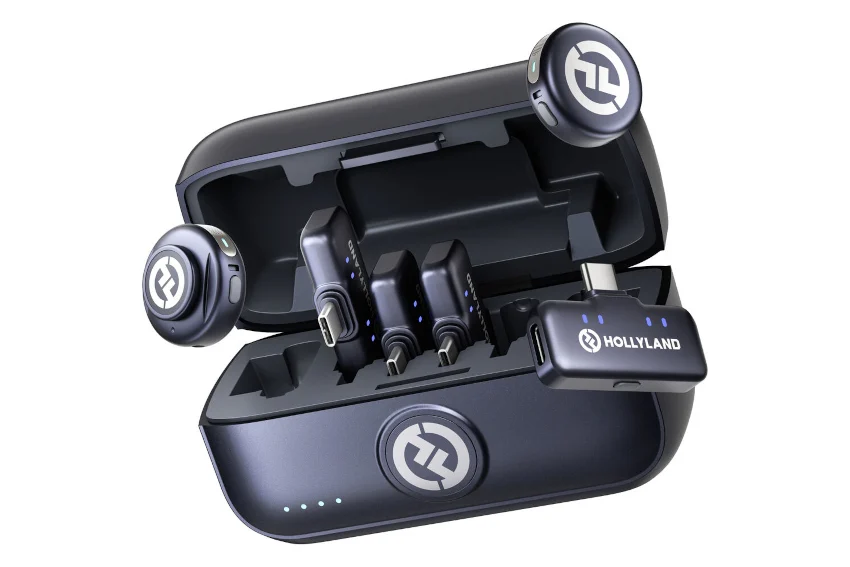
As modern content production shifts toward increasingly collaborative environments, complex multi-camera setups, and spontaneous on-location shoots, the demands placed on wireless audio technology have never been higher. Traditional wireless microphone systems—typically designed around a rigid, fixed one-to-one or two-to-one architecture—often struggle to keep pace with contemporary workflows. Interviews frequently involve multiple fluctuating speakers, podcasts demand dynamic routing of several microphones, and multi-camera shoots require pristine audio feeds to reach numerous recording devices simultaneously without latency or degradation.
Entering this dynamic landscape is the Hollyland LARK M3, an innovative and highly scalable wireless audio ecosystem built from the ground up around a versatile multi-transmitter and multi-receiver architecture. Moving far beyond the limitations of conventional fixed-kit wireless mics, the LARK M3 introduces configurable routing topologies—supporting both one-to-many and many-to-one applications. This gives filmmakers, documentarians, podcasters, and content creators the unprecedented flexibility to scale their audio infrastructure up or down depending on the exact parameters of any given production.
Main Facts: The Anatomy of the Hollyland LARK M3
At its core, the Hollyland LARK M3 reimagines how wireless audio components interact on set. Rather than locking users into a single operating mode, the system treats transmitters and receivers as an interconnected, flexible audio network.
Flexible Routing Configurations
The defining technical characteristic of the LARK M3 is its bidirectional scalability. The system can be configured in several powerful ways:
- Many-to-One (Up to 4 Transmitters to 1 Receiver): Users can connect up to four independent transmitters to a single receiver. This makes it an ideal solution for roundtables, group interviews, and multi-person podcast recordings, allowing each participant to wear their own discrete microphone.
- One-to-Many (1 Transmitter to Up to 4 Receivers): The architecture can be completely reversed. A single transmitter can beam its audio feed simultaneously to up to four distinct receivers. This is a game-changer for multi-camera productions or hybrid shoots utilizing multiple mirrorless cameras and smartphones, ensuring every recording device captures the exact same master audio source cleanly and synchronously.
Hollyland offers the LARK M3 in a wide variety of bundled configurations and standalone SKUs—including combinations featuring four transmitters and two receivers, two transmitters and four receivers, two transmitters and two receivers, and classic two-transmitter/single-receiver kits.
Audio Quality and Professional Processing Specs
Technical capability matches routing flexibility. The LARK M3 records in crisp 48 kHz/32-bit float audio, providing a massive dynamic range that acts as an insurance policy against clipped audio during unexpected loud noises or whispered dialogue. It also supports standard 48 kHz/24-bit audio workflows.
Furthermore, the hardware boasts an impressive 70 dB signal-to-noise ratio (SNR) and can handle a 125 dB maximum Sound Pressure Level (SPL). To ensure clean dialogue straight out of the box, Hollyland integrated several advanced computational tools:
- AI Noise Cancellation: Powered by deep learning and computational auditory scene analysis, this system filters out environmental disturbances across three adjustable levels (tackling wind, traffic, and background hums).
- Vocal Presets and Fine-Tuning: Users can select and customize specific vocal profiles directly for individual transmitters, minimizing the need for heavy EQ manipulation later in post.
- Auto-Limit Clip Protection: Intelligently guards against sudden audio peaks, preventing digital distortion before it hits the recording media.
Transmission Range and Hardware Durability
Designed for demanding field use, the LARK M3 boasts a wireless transmission range of up to 300 meters (approx. 1,000 feet) under open, unobstructed line-of-sight conditions. An integrated RF interference-resistant circuit helps maintain connection stability in congested urban zones, event venues, and corporate offices.
Despite housing advanced electronics, each transmitter weighs an featherlight 9 grams and utilizes a secure magnetic mounting system for discreet attachment to wardrobe.
Chronology and Evolution: The Journey to Scalable Audio Networks
To truly understand the significance of the LARK M3, it helps to examine the evolutionary timeline of wireless audio technology over the past decade.
- The Analog Era (Pre-2010s): Wireless audio was predominantly analog, expensive, and notoriously prone to radio frequency (RF) interference. Multi-mic setups required heavy frequency coordination, massive receiver racks, and extensive technical expertise.
- The Rise of Compact Digital (2018–2022): Brands like Rode, DJI, and Hollyland revolutionized the creator economy by introducing ultra-compact, 2.4GHz digital wireless clip-on microphones. These systems democratized professional sound, making wireless audio affordable and plug-and-play. However, they remained strictly tethered to fixed configurations—typically two transmitters talking to one dual-channel receiver.
- The Multi-Device Demand (2023–2025): As social media content evolved into complex cinematic vlogs, multi-cam live streams, and intricate podcast setups, creators routinely ran into hardware bottlenecks. Using four mics meant buying entirely separate systems or dealing with messy multi-receiver syncing issues in post-production.
- The Introduction of the LARK M3 (Late 2025 / 2026): Hollyland identified this industry-wide bottleneck and engineered a unified hardware ecosystem. By allowing dynamic pairing configurations (up to 4-to-1 or 1-to-4), the LARK M3 bridges the gap between consumer-grade simplicity and enterprise-level broadcast scalability.
Supporting Data and Technical Specifications
A closer examination of the LARK M3’s data sheet reveals a device engineered to perform under rigorous professional standards:

| Feature / Metric | Specification Detail |
|---|---|
| Audio Resolution | 48 kHz / 32-bit Float (also supports 48 kHz / 24-bit) |
| Signal-to-Noise Ratio (SNR) | 70 dB |
| Maximum SPL | 125 dB |
| Maximum Line-of-Sight Range | Up to 300 meters (~1,000 feet) |
| Transmitter Weight | Approx. 9 grams |
| Mounting Mechanism | Magnetic attachment + clothing clips |
| Battery Life (Per Transmitter) | Up to 8 hours per charge |
| Max Extended Runtime | Up to 48 hours continuous operation via charging case (using alternating transmitter rotation modes) |
| Track Output | Up to 4 independent audio tracks (via USB-C or compatible third-party software / Hot Shoe adapters) |
Receiver Redundancy and Reliability
When operating in complex multi-receiver setups, system failure is not an option. The LARK M3 addresses this via a Primary and Secondary Receiver Architecture. The Primary Receiver handles master transmitter configurations, while secondary units monitor status in real-time. Should the primary unit unexpectedly drop offline, secondary receivers can automatically assume control, maintaining continuous audio capture without manual crew intervention.
Official Responses and Manufacturer Intentions
According to product releases and engineering statements from Hollyland, the primary objective behind the LARK M3 was to eliminate the structural rigidity that has plagued wireless microphone kits for years.
"As productions become more collaborative and camera setups grow more complex, wireless audio has to scale accordingly," noted product development representatives at Hollyland. The company set out to create a system that does not force creators to purchase entirely new hardware kits every time a project scales up from a single-camera interview to a multi-cam panel discussion.
By treating transmitters and receivers as interchangeable nodes within a localized network, Hollyland aims to provide broadcast-level flexibility to independent creators, corporate video teams, and mobile journalists alike.
Implications for Filmmakers, Creators, and Post-Production Workflows
The introduction of the Hollyland LARK M3 carries profound implications across multiple facets of the media production industry:
1. Revolutionizing Post-Production Efficiency
When paired with compatible recording software via USB-C or utilized with appropriate Hot Shoe adapter configurations, the LARK M3 outputs up to four independent audio tracks. For video editors and sound designers, this is a massive win. Instead of receiving a single "baked-in" stereo mix where multiple speakers bleed into one another, editors retain absolute discrete control over every voice. Dialogue levels can be balanced independently, individualized noise reduction and EQ can be applied, and accidental volume spikes from one speaker will never ruin the track of another.
2. Streamlining Multi-Camera and Mobile Hybrid Shoots
For event videographers, wedding shooters, and live-streamers utilizing multiple camera bodies or mobile phones simultaneously, sending a single transmitter’s signal to up to four distinct receivers eliminates the nightmare of audio syncing across disparate devices in post. One pristine audio source is distributed hardware-side straight to every camera’s microphone input.
3. Economic and Spatial Efficiency
Carrying heavy Pelican cases stuffed with disparate wireless systems is quickly becoming obsolete. With the LARK M3’s comprehensive charging case architecture—which securely houses transmitters, receivers, magnetic mounts, cables, and furry windshields—crews can pack an entire scalable audio network into a pocket-sized footprint. Furthermore, the ability to scale a single system up or down represents a significant cost-saving measure for freelance creators who frequently pivot between solo-shooting and large crew environments.
Final Thoughts
The Hollyland LARK M3 successfully redefines what creators should expect from a portable wireless microphone system. By dismantling the traditional barriers of fixed-channel architectures and replacing them with a fluid, scalable network of up to four transmitters and four receivers, Hollyland has delivered a remarkably versatile tool.
Coupled with professional-grade 48 kHz/32-bit float audio, AI-driven environmental noise cancellation, ultra-lightweight 9-gram hardware, and robust receiver redundancy, the LARK M3 is expertly positioned to grow alongside the ambitions of modern filmmakers, podcasters, and multi-camera production crews. Whether tackling a chaotic run-and-gun documentary or a controlled studio roundtable, the LARK M3 ensures your audio infrastructure is never the weak link in your creative vision.
