
Literary Icon and Cinematic Visionary: Ryu Murakami Remembered (1952–2026)
Main Facts
The literary and cinematic worlds are mourning the loss of Ryu Murakami, the celebrated Japanese novelist, essayist, and filmmaker whose unflinching, visceral storytelling helped redefine modern Japanese literature and inspired some of the most unsettling masterpieces of contemporary horror cinema. Murakami passed away at his home on October 17, at the age of 74, his publisher, Gentosha, announced. As of the time of reporting, no official cause of death has been released.
Murakami leaves behind a staggering legacy spanning five decades, characterized by more than forty novels and story collections. While international audiences may know him best as the architectural mind behind Audition—the chilling 1997 psychological thriller adapted into Takashi Miike’s iconic 1999 film—Murakami was a literary titan long before his work entered the global horror consciousness. His writing consistently probed the dark underbelly of post-war Japanese society, exploring alienation, hedonism, sex, violence, and the psychological fractures of a rapidly westernized nation.
His death marks the end of an era for Japanese letters, coming just months after the passing of Koji Suzuki, the author of Ring, in May. Together, Murakami and Suzuki served as foundational literary pillars for the explosive global wave of Japanese horror that dominated the late 1990s and early 2000s, proving that modern terror could stem just as easily from human pathology as it could from supernatural specters.
Chronology: A Life in Letters and Cinema
Early Life and Breakthrough (1952–1976)
Ryu Murakami was born on February 19, 1952, in Sasebo, a port city in Nagasaki Prefecture. Growing up near a major U.S. naval base, Murakami was exposed to an eclectic mix of traditional Japanese culture and American pop culture—a cultural duality that would profoundly influence his later artistic sensibilities.
As a youth, Murakami gravitated toward music, film, and countercultural literature. He moved to Tokyo to attend Musashino Art University, immersing himself in the vibrant, politically charged, and hedonistic counterculture of the 1970s.
In 1976, at the young age of 24, Murakami achieved meteoric literary success with his debut novel, Almost Transparent Blue. The semi-autobiographical book chronicled the drug-addled, sexually liberated, and alienated lives of a group of disaffected youth living near a U.S. military base. The novel captured the disillusionment of a generation and was instantly embraced by critics. It won the prestigious Gunzo Prize for New Writers, followed quickly by the Akutagawa Prize—Japan’s highest literary honor for a work of new fiction. Overnight, Murakami transformed from an unknown art student into the bad boy of Japanese literature, a title he would both court and transcend over the next fifty years.
Prolific Output and Cinematic Expansion (1977–1999)
Rather than resting on his laurels, Murakami launched into a relentlessly prolific writing career. He quickly expanded his repertoire beyond raw countercultural fiction into psychological thrillers, social satires, and dark dramas.
In 1979, Murakami stepped behind the camera for the first time to direct a cinematic adaptation of his debut novel, Almost Transparent Blue. This began a parallel career as a filmmaker. Over the next two decades, he directed four more feature films: All Right, My Friend (1979), Raffles Hotel (1989), Topaz (1992)—released internationally as Tokyo Decadence—and Kyoko (2000).
His literary output during the 1980s and 1990s cemented his reputation as a master of psychological tension. In 1994, he published Piercing, a dark, claustrophobic psychological cat-and-mouse game between a family man hiding murderous impulses and a fragile sex worker. This was followed in 1997 by Audition, a deceptively calm narrative about a widowed film producer who stages a fake casting call to find a new wife, only to ensnare himself with Asami, a former ballet dancer harboring unimaginable depths of cruelty.
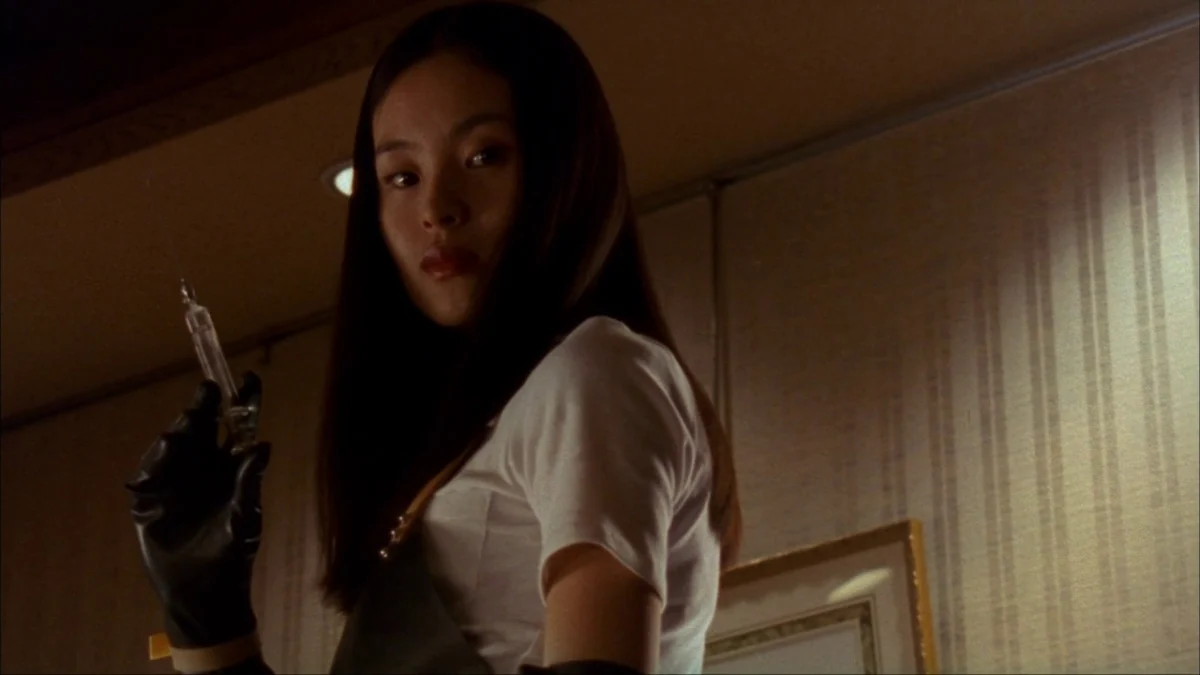
Audition caught the eye of avant-garde Japanese director Takashi Miike, who adapted it into a 1999 feature film. Released at the height of the global J-horror wave catalyzed by Hideo Nakata’s Ringu (1998), Miike’s Audition became an international cult phenomenon. Eihi Shiina’s portrayal of Asami—epitomized by her chillingly cheerful repetition of the word “kiri-kiri-kiri” while brandishing acupuncture needles—became the benchmark for female villainy in modern horror.
Late Career and Unfilmed Masterpieces (2000–2026)
As the new millennium dawned, Murakami continued to push artistic boundaries. His 1994 novel In the Miso Soup, which followed an American tourist wandering through Tokyo’s red-light district with a sinister tour guide on New Year’s Eve, won the prestigious Yomiuri Prize for Fiction in 2000.
Other filmmakers eagerly sought out his bibliography. Director Lee Sang-il adapted Murakami’s nostalgic 1998 novel 69 in 2004, while Tetsuo Shinohara brought Karaoke Terror to the screen in 2003. In 2018, American filmmaker Nicolas Pesce adapted Piercing into a stylish, psychological thriller starring Christopher Abbott and Mia Wasikowska.

Despite his extensive cinematic footprint, a vast majority of Murakami’s literary shelf remained untouched by Hollywood or domestic studios. Epics and complex psychological masterworks like Coin Locker Babies (1980)—a sprawling, hallucinatory tale of two babies abandoned in train station coin lockers who grow up to navigate a dystopian Tokyo—and his massive geopolitical thriller From the Fatherland, with Love (2005) remained strictly on the page, celebrated as towering achievements of Japanese fiction that defied easy translation to the screen.
Supporting Data: The Murakami Bibliography and Filmography
To understand the immense scope of Ryu Murakami’s career, one must examine the intersection of his literary creations and their cinematic adaptations:
Selected Major Novels
- Almost Transparent Blue (1976): Akutagawa Prize winner; explores countercultural youth, drugs, and alienation.
- Coin Locker Babies (1980): A sprawling dystopian masterpiece concerning two abandoned infants and societal decay.
- Piercing (1994): A psychological thriller examining trauma, compulsion, and violence.
- In the Miso Soup (1994): Yomiuri Prize winner; a harrowing nocturnal descent into the neon-lit underbelly of Tokyo.
- Audition (1997): The minimalist psychological horror novel that birthed Asami.
- 69 (1998): A vibrant, semi-autobiographical coming-of-age story set against the 1969 student protests.
- From the Fatherland, with Love (2005): A complex geopolitical thriller concerning a North Korean invasion of Fukuoka.
Directorial Filmography
- Almost Transparent Blue (1979)
- All Right, My Friend (1979)
- Raffles Hotel (1989)
- Topaz / Tokyo Decadence (1992)
- Kyoko (2000)
Major Cinematic Adaptations of His Work
- Audition (1999) – Directed by Takashi Miike; based on the 1997 novel.
- Karaoke Terror (2003) – Directed by Tetsuo Shinohara.
- 69 (2004) – Directed by Lee Sang-il.
- Piercing (2018) – Directed by Nicolas Pesce.
Official Responses and Tributes
Following the announcement of his passing by Gentosha, tributes poured in from literary institutions, fellow authors, and filmmakers worldwide.
The Japan Foundation released a statement praising Murakami as “a visionary architect of the modern human psyche, whose refusal to look away from society’s darkest corners fundamentally expanded the global vocabulary of literature.”
Filmmaker Takashi Miike, whose cinematic adaptation of Audition forever linked his name with Murakami’s, shared a deeply emotional reflection:
"Ryu Murakami gave us the blueprint for the modern nightmare. When I read Audition, I wasn’t just reading a story; I was looking into a mirror that reflected the anxieties of our age. Asami was his creation first, and she remains one of the most complex, terrifying, and profoundly tragic characters in modern fiction. Losing him is like losing the lighthouse that guided us through the dark waters of contemporary storytelling."
Publishers and booksellers across Japan announced plans retrospective displays of his work, while international literary festivals dedicated upcoming panels to discussing his enduring impact on transgressive fiction.
Implications: A Lasting Legacy on Global Culture
The passing of Ryu Murakami is not merely the loss of a prolific Japanese novelist; it marks the fading of a generation of artists who dared to dismantle post-war optimism and expose the structural and psychological rot beneath the economic miracles of the late twentieth century.
Murakami’s work anticipated many of the anxieties that define the twenty-first century: hyper-consumerism, digital and emotional isolation, the commodification of intimacy, and the sudden, random eruptions of violence in orderly societies. While figures like Koji Suzuki utilized ghosts, cursed videotapes, and supernatural curses to explore societal fears, Murakami found a far more terrifying subject: ordinary human beings.
In Audition, the horror does not stem from a vengeful spirit rising from a well, but from a lonely man seeking a compliant wife, and a deeply traumatized woman executing a meticulously planned retribution. By stripping away the supernatural, Murakami demonstrated that human cruelty requires no magic to be monstrous.
Furthermore, Murakami proved that Japanese literature could be aggressively modern, globally minded, and formally daring without losing its distinct cultural identity. His influence reverberates through the works of contemporary international thriller and horror writers who continue to mine his bibliography for blueprints on how to write about trauma, alienation, and desire.
As readers and cinephiles revisit Audition, In the Miso Soup, Coin Locker Babies, and his extensive cinematic catalog, Ryu Murakami’s voice remains as sharp, transparent, and hauntingly vibrant as it was when he first stunned the literary world fifty years ago. He leaves behind a landscape forever altered by his courage to write the unmentionable.
