
Sunshine on Leith: A Theatrical Jukebox Musical Caught Between Charm and Cliché
Introduction: The Scottish Singalong
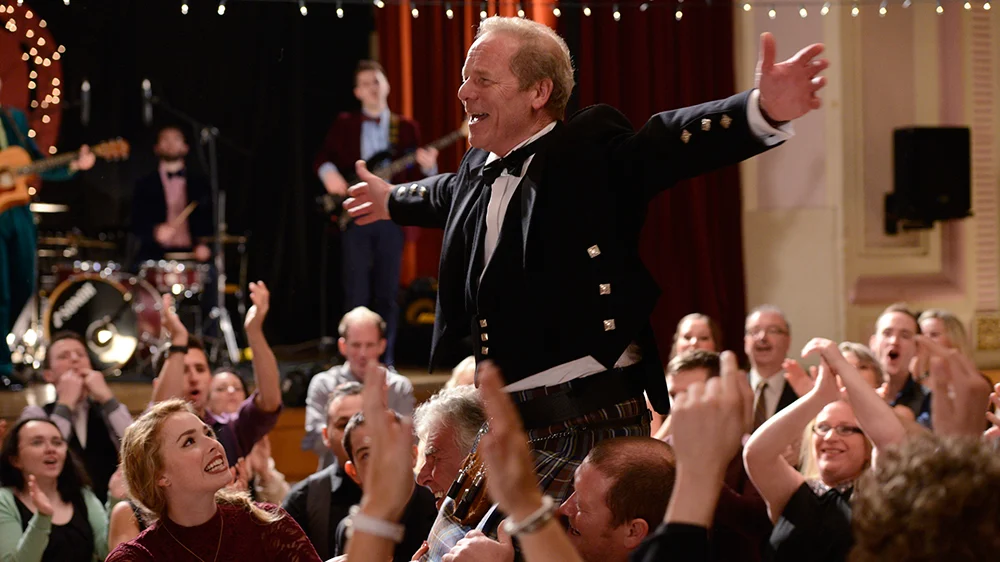
"Sunshine on Leith," the big-screen adaptation of the hit stage musical, arrives with the boisterous energy of a local pub singalong and the sentimental polish of a tourism board advertisement. Directed by Dexter Fletcher, the film is a jukebox musical built entirely around the songbook of Scottish icons The Proclaimers. It is a work of unabashed "heart-on-sleeve" storytelling that operates on a binary frequency: for some, it will be an irresistible, toe-tapping romp; for others, a cloying, formulaic exercise in schmaltz.
As the film prepares for its U.K. release, industry analysts are watching closely. While the domestic market in Britain is expected to embrace the film’s populist, feel-good narrative, the reception in international territories remains an open question. The film occupies a space of "reassuring familiarity," offering a narrative that prioritizes emotional safety over artistic risk.
The Narrative Arc: A Story of Veterans and Domestic Turmoil
The plot follows two lifelong best friends, Davy (George MacKay) and Ally (Kevin Guthrie), who have returned to their native Edinburgh after a harrowing tour of duty in Afghanistan. Their homecoming is shadowed by the trauma of war—specifically, a road mine explosion that left several of their comrades killed or maimed.
The transition to civilian life is portrayed as a mundane, almost comedic struggle. The duo finds themselves relegated to the humdrum reality of telemarketing—a stark contrast to the life-or-death stakes they faced abroad. As they attempt to reintegrate into the social fabric of Edinburgh, their personal lives begin to diverge. Ally attempts to rekindle his romance with Davy’s sister, Liz (Freya Mavor), though their visions of the future are fundamentally misaligned; Ally yearns for domestic stability, while Liz is driven by a restless hunger to see the world.
Meanwhile, Davy finds a romantic spark with Yvonne (Antonia Thomas), a nurse and London transplant who works with his sister. While their relationship blooms, the elder generation faces its own seismic shifts. Davy and Liz’s parents, played by Peter Mullan and Jane Horrocks, are on the precipice of their 25th wedding anniversary. However, a long-hidden secret—the discovery of an adult daughter from an extramarital affair—threatens to dismantle the foundation of their marriage.
The film weaves these disparate threads together through a series of convenient, highly telegraphed crises. Just as the three couples find themselves at an impasse, a well-timed medical emergency serves as the catalyst for reconciliation, forcing the characters to set aside their grievances and embrace the film’s central thesis: that love, while difficult, is the ultimate restorative force.
Chronology of Production and Aesthetic Choices
The journey from stage to screen for "Sunshine on Leith" was marked by a desire to capture the "working-class vibe" of the Proclaimers’ discography. Dexter Fletcher, transitioning from a career in front of the camera to the director’s chair, sought to create a film that felt unpretentious and accessible.
However, the production design often struggles to escape its theatrical origins. The cinematography, while utilizing the expansive vistas of Edinburgh, frequently takes on a "televisual" quality, particularly in the widescreen HD presentation of city landscapes. The musical sequences, choreographed by Rosie Kay, are notably modest. Rather than pushing the cast with complex or high-stakes movement, the choreography is designed to look like something one might see in a school pageant or a community theater production. While this approach is consistent with the film’s "down-to-earth" aspirations, it also risks appearing calculated or "prepackaged," failing to elevate the material beyond its modest roots.
Supporting Data and Performance Analysis
At the heart of the film’s success—or lack thereof—is the music of Charlie and Craig Reid. The Proclaimers’ folk-inflected pop tunes are inherently catchy, yet in this context, they are often described as "bland." The film’s most famous inclusion, "I’m Gonna Be (500 Miles)," is utilized twice. The second appearance, serving as the climactic production number, is intended to be a grand, rousing finale, though it serves primarily as a reminder of the film’s reliance on established hits rather than original innovation.
Performance-wise, the ensemble is a mixed bag. Peter Mullan is widely regarded as the film’s anchor, providing a much-needed sense of gravity to a screenplay that otherwise leans heavily into "cutesiness." Jane Horrocks provides the bulk of the film’s lighter, more whimsical energy, which may prove grating to viewers with a lower tolerance for sentimentality. The younger leads—MacKay, Guthrie, Mavor, and Thomas—are described as "pleasant enough," delivering capably sung performances that fit the film’s easy-listening aesthetic. Paul Englishby’s background score, unfortunately, adds a layer of "syrupy" sentimentality that underscores the film’s more banal dialogue.
Official and Critical Perspectives
The critical consensus surrounding "Sunshine on Leith" is one of polite dismissal tempered by an acknowledgment of its target demographic. The screenplay is often criticized for its "pat development" and predictable resolution. The dialogue, designed to reiterate that the characters are "decent people," rarely challenges the audience.
From an industry perspective, the film is categorized as a "rote crowdpleaser." The reliance on cliché—the hidden secret, the military return, the marital crisis—is seen as a deliberate choice to satisfy the audience’s desire for emotional highs and lows without the burden of complex narrative development.
Marketing efforts for the film have focused heavily on the "Scottish pride" angle, utilizing the picturesque backdrop of Edinburgh to appeal to both local audiences and the global diaspora. However, as the film moves toward international markets, the lack of a distinctive visual signature or "star power" may hamper its ability to capture a wider, non-British audience.
Implications for the Jukebox Musical Genre
"Sunshine on Leith" serves as a case study for the risks inherent in the jukebox musical genre. When a film relies so heavily on a pre-existing songbook, it risks becoming a mere vehicle for those songs, with the narrative serving as little more than a frame for the music. In this instance, the film succeeds in its primary goal: to be an unpretentious, populist musical that reinforces traditional values.
However, the implications for the genre are clear: as audiences become more sophisticated, the "cutesy" formula that worked for stage productions in the early 2000s may struggle to maintain the same relevance in cinema. The "televisual" look and the simplified choreography suggest that while the film may satisfy a specific, local nostalgia, it may struggle to define itself as a lasting piece of cinema.
Ultimately, the film asks its viewers to accept its flaws as part of its charm. It is a work that wears its heart on its sleeve, unapologetic about its reliance on tropes, and confident that the simple, catchy lyrics of the Reid brothers—and the universal themes of home, love, and reconciliation—will be enough to win over the audience. Whether this formula translates into long-term commercial viability outside the United Kingdom remains to be seen, but for now, "Sunshine on Leith" stands as a testament to the enduring power of the "chirpy heart-on-sleeve" musical tradition.
