
The Echo of an Empire: Assessing Aaron Sorkin’s ‘The Social Reckoning’
In 2010, David Fincher’s The Social Network arrived with the weight of a cultural earthquake. It was a film that dared to dissect an entity—Facebook—that was still in its adolescence, capturing a digital revolution while the revolution was still in the streets. At the time, skeptics argued it was too soon; in hindsight, that prematurity was its greatest strength. It served as a cold, clinical, and profoundly prescient warning that the platform connecting our lives was being built by a man whose ambitions were, at best, fundamentally disconnected from human empathy.
Sixteen years later, screenwriter Aaron Sorkin returns to the digital battlefield with The Social Reckoning, a film that attempts to hold the tech giant accountable for the societal erosion that followed. Yet, where the original film felt like a prophecy, The Social Reckoning arrives feeling like an autopsy of a crime we have already solved.
The Chronology of a Digital Collapse
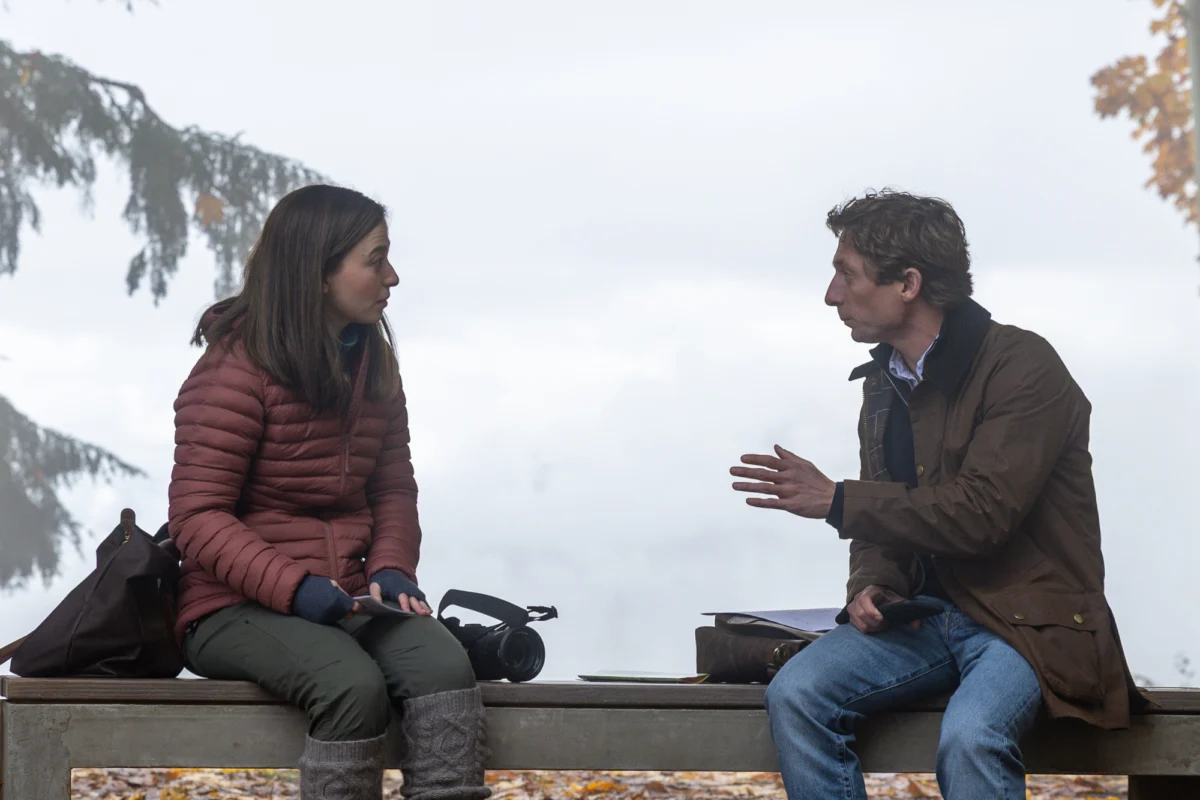
The Social Reckoning centers its narrative lens on the period between 2019 and 2021—a pivotal window that saw Facebook transition from a ubiquitous social utility to an engine of global polarization. Sorkin adopts a procedural structure, documenting the meticulous investigation led by Wall Street Journal reporter Jeff Horwitz (Jeremy Allen White) and his primary source, the Facebook whistleblower Frances Haugen (Mikey Madison).
The film’s chronology is anchored by the internal struggle at the company’s Menlo Park headquarters. It tracks the degradation of the platform’s "Civic Integrity" team—a department established to police misinformation, only to be systematically defanged by executive leadership. The narrative trajectory moves from the subtle internal warnings of 2019 to the explosive public hearings of 2021, culminating in Haugen’s testimony before the U.S. Senate Commerce Committee. By ending on this note of legislative confrontation, Sorkin attempts to frame the story as a victory for truth-telling. However, in the context of 2026, where Facebook remains an largely unregulated landscape of toxic discourse, the film’s climax feels less like a triumphant resolution and more like a fleeting, quaint footnote.
Supporting Data and the Mechanics of Radicalization
Sorkin does not shy away from the granular data that defined the "Facebook Files," the series of exposés that shattered the company’s carefully curated public image. The film presents, with clinical precision, the algorithmic reality that drove 64% of users who joined extremist groups to those communities via the platform’s own recommendation engines.
The film opens with a provocative, albeit schematic, prologue involving a character named Kayleigh (Portia Doubleday). Her descent from a moderate citizen to a radicalized participant in a white-supremacist Facebook group serves as a microcosm of the platform’s broader systemic failures. This sequence is designed to illustrate how the pursuit of "engagement"—the metric that drives Zuckerberg’s empire—is inherently antithetical to social cohesion. When Haugen presents data suggesting that a mere 1% reduction in engagement could mitigate radicalization, the film’s Zuckerberg (Jeremy Strong) provides the expected, chillingly indifferent response: the numbers must go up, regardless of the cost to the social fabric.
Character Studies: The Architect vs. The Whistleblower
The dramatic heart of the film lies in the friction between its leads. Jeremy Allen White’s portrayal of Jeff Horwitz provides a weary, "shoe-leather" journalistic grounding, serving as a foil to Mikey Madison’s energetic, idealistic Frances Haugen. Their dynamic is written with Sorkin’s signature rapid-fire dialogue—a "sexless quasi-romcom" of intellectual sparring that highlights the generational divide between a traditionalist reporter and a digital-native whistleblower.
However, the film’s greatest challenge is the character of Mark Zuckerberg. In 2010, Jesse Eisenberg’s portrayal captured a "boy sociopath" in the making—a character defined by his intellectual isolation and social armor. In The Social Reckoning, Jeremy Strong portrays a version of Zuckerberg that has reached his "final form." He is emotionally distant, inscrutable, and fundamentally alien. While this may align with the public perception of the billionaire today, it creates a dramatic void. A protagonist—or in this case, an antagonist—who has become entirely static leaves the audience with little to hold onto. He is no longer the ambitious underdog; he is the immovable object, and the film struggles to find a way to challenge him that feels anything other than performative.
Official Responses and the Industry Backdrop
It is important to note that The Social Reckoning functions as a historical document of a company that has, since the 2021 events depicted, successfully pivoted its brand toward the Metaverse and artificial intelligence. The film’s focus on the "Facebook Files" era is a direct challenge to the company’s past, yet the film itself is curiously quiet regarding the current era of generative AI.
By framing the story strictly within the 2019–2021 window, Sorkin avoids the complexities of the current AI-driven disinformation crisis. Critics have suggested this makes the film feel like a "period piece," disconnected from the immediate, existential threats currently posed by algorithmic amplification. There is no official statement from the current Meta leadership regarding this specific portrayal, as the company has long adopted a strategy of silence in response to dramatic adaptations of its history. Instead, the "official" response is found in the continued, unchecked growth of the platform itself—a reality that makes Sorkin’s moralizing feel like a shouting match in an empty room.
Implications: The Limits of the Sorkin Style
The fundamental tension of The Social Reckoning is that it is a Sorkin film directed by Sorkin. Without the visual coldness and structural tension provided by David Fincher in the original, the story loses its "shadowy mood-mongering." Instead, we are given the earnest, speechifying idealism that defined The West Wing and The Trial of the Chicago 7.
Sorkin’s screenplay is peppered with references to Frank Capra, a director known for his optimistic belief in the American spirit. But the world of digital surveillance and algorithmic manipulation is not a Capra movie. When Sorkin attempts to apply his signature brand of combative, witty patter to the boardroom of a tech giant, it often misses the mark. The inclusion of skeptical consultants and crisis managers feels like a stylistic affectation rather than a genuine exploration of the corporate machinery.
Ultimately, the implications of The Social Reckoning are twofold:
- The Saturation of the Narrative: The public is already well-versed in the dangers of Facebook. By repeating the narrative of "truth to power" without offering new insight into how we might dismantle these structures, the film risks exhaustion rather than inspiration.
- The Evolution of the Medium: The film serves as a stark reminder that traditional narrative cinema is struggling to keep pace with the hyper-speed of the internet. The "tech wars" have shifted so dramatically in the last five years that a film focused on the events of 2021 feels like it is reporting from a bygone era.
In his final assessment, Sorkin seems to mourn the loss of what Facebook could have been—a place where friends connected and communities flourished. But in doing so, the film itself feels like a downgrade from the original. It is less human, less candid, and, ironically, less connected.
As we look toward the future of media, The Social Reckoning stands as a testament to the limitations of looking backward. While it is a capably mounted piece of filmmaking, it ultimately fails to capture the terrifying, shifting reality of a world dominated by the very algorithms it seeks to condemn. We are left with a film that is clever, true, and ultimately, largely irrelevant to the crises that define our present day.
