
The Weight of Reasonable Doubt: Jim Sheridan’s Re-Creation Challenges the Ethics of True Crime
By Editorial Staff
October 4, 2026
In the landscape of modern cinema, the courtroom thriller remains a perennial favorite, serving as a mirror for society’s collective anxieties regarding justice, truth, and the fallibility of the human mind. Yet, rarely does a film arrive that blurs the lines between documentary observation and dramatic staging as aggressively as Re-Creation. Co-directed by the legendary Irish filmmaker Jim Sheridan and David Merriman, this gripping feature—which premiered to significant buzz at the 2025 Tribeca Film Festival—has now made its debut on VOD via Kino Lorber, bypassing a traditional theatrical release to arrive directly in the living rooms of those eager to dissect its haunting premise.
The Premise: A Trial That Never Was
At its core, Re-Creation functions as a sophisticated, modern-day spiritual successor to Sidney Lumet’s 12 Angry Men. However, rather than operating within the confines of a standard narrative, Sheridan and Merriman utilize a "fictionalized jury" to re-examine the real-world, cold-case murder of French film producer Sophie Toscan du Plantier, who was killed in West Cork, Ireland, in 1996.
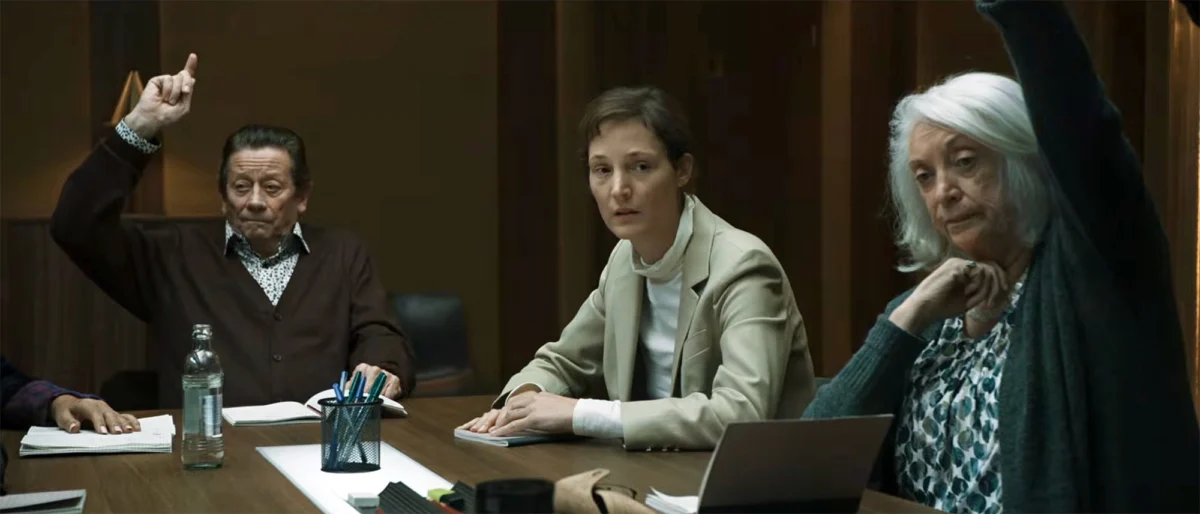
The film follows twelve jurors—led by the formidable Vicky Krieps—as they deliberate on the guilt or innocence of the late British journalist Ian Bailey. The case, which famously saw Bailey convicted in absentia by a French court but never successfully prosecuted in Ireland, remains one of the most contentious chapters in Irish criminal history. By placing a group of strangers in a room to debate the evidence, Re-Creation forces the audience to confront the limitations of the legal system and the dangerous subjectivity of "truth."
Chronology of a Cold Case
To understand the gravity of Re-Creation, one must understand the shadow of the case it depicts. The death of Sophie Toscan du Plantier on December 23, 1996, sparked a decades-long media frenzy and a labyrinthine legal battle that spanned two countries.

- December 1996: Sophie Toscan du Plantier is found murdered near her holiday home in Toormore, County Cork. The local investigation is marred by allegations of incompetence and mishandling of evidence.
- 1997–2010: Ian Bailey, a journalist living in the area, becomes the prime suspect. He is arrested twice but never charged by the Irish Director of Public Prosecutions due to a lack of admissible evidence.
- 2019: In a landmark move, a French court convicts Bailey of the murder in absentia. He is sentenced to 25 years in prison, though the Irish courts refuse to extradite him, citing concerns over the fairness of the French process.
- 2024: The death of Ian Bailey effectively ends the possibility of a definitive legal resolution.
- 2025: Jim Sheridan and David Merriman unveil Re-Creation at the Tribeca Film Festival, offering a new, speculative forum for the case.
Artistic Vision and Supporting Cast
Jim Sheridan, the visionary behind My Left Foot and In the Name of the Father, has long been fascinated by the intersection of individual rights and institutional power. With Re-Creation, he shifts his focus toward the audience, turning the film into a mirror of our own biases.
The film’s strength lies in its ensemble cast. Vicky Krieps, known for her magnetic, nuanced performances in Phantom Thread and Corsage, anchors the film as "Juror #8," a role that evokes the moral gravity of Henry Fonda’s iconic portrayal in the 1957 classic. Her presence provides the intellectual heartbeat of the film, as she pushes her fellow jurors to look past the sensationalist headlines and consider the granular, often contradictory details of the evidence.
Aidan Gillen, Colm Meaney, and John Connors round out the ensemble, each bringing a specific archetypal perspective that reflects the broader public discourse surrounding the du Plantier case. Meaney’s involvement is particularly poignant, as he brings a seasoned gravity to the proceedings that elevates the script’s procedural elements into a meditation on the nature of memory.
The Ethics of True Crime: Implications
Re-Creation arrives at a pivotal moment in the evolution of the "True Crime" genre. As podcasts and streaming documentaries have turned real-life tragedies into entertainment, there has been an increasing backlash regarding the exploitation of victims. Sheridan and Merriman navigate this minefield by acknowledging the "fictionalized" nature of their experiment.
By casting actors to play jurors and re-enacting the debate, the film distances itself from the pretense of being a "definitive" solution to the case. Instead, it serves as a philosophical inquiry: Is justice possible in the court of public opinion?

The film’s implications are far-reaching. It challenges the viewer to recognize how media coverage, personal prejudices, and the charisma of a suspect—or the lack thereof—can dictate the outcome of a trial long before the jury enters the room. This makes Re-Creation not just a film about a specific murder, but a film about the mechanics of human judgment.
Critical Comparison: A Trend of Juror-Centric Narratives
It is impossible to discuss Re-Creation without noting the current cinematic preoccupation with the jury system. With Clint Eastwood’s Juror #2 (starring Nicholas Hoult) exploring similar themes of moral conflict within the jury box, Re-Creation feels part of a larger, zeitgeist-driven investigation into the burden of civic duty.
While Eastwood’s film leans into the high-stakes thriller aesthetic of a guilty juror, Sheridan and Merriman’s film is more contemplative. It is a "heady" experience, as described by early reviews, that refuses to offer the catharsis of a "solved" case. For viewers accustomed to the neat resolutions of network procedurals, Re-Creation may prove challenging. It offers no gavel-banging finale, only the lingering, uncomfortable question: What would you have decided?
Official Responses and Accessibility
Kino Lorber’s decision to move Re-Creation straight to VOD reflects a changing distribution model for mid-budget, intellectually demanding dramas. While some cinephiles may lament the lack of a theatrical release, the VOD strategy allows for a more immediate, intimate engagement with the material.
The filmmakers have maintained that the project was born from an original idea by Sheridan, who felt that the formal structures of traditional documentaries were insufficient to capture the psychological complexity of the du Plantier case. "We didn’t want to tell people what to think," the production team noted during the Tribeca run. "We wanted to provide the tools for them to think for themselves."

Conclusion: The Case Remains Open
Re-Creation is a testament to Jim Sheridan’s enduring ability to reinvent himself and his craft. By blending the historical weight of the Toscan du Plantier tragedy with the structural rigor of a courtroom drama, he has created a film that is as much about the process of thinking as it is about the act of killing.
For those interested in the intricacies of the Irish legal system, the history of this notorious case, or simply the craft of high-stakes acting, Re-Creation is an essential watch. It does not provide a verdict, nor does it claim to uncover new evidence that was missed by police. Instead, it asks something far more difficult: in a world obsessed with narrative, are we capable of seeing the truth?
As the credits roll, the film leaves the viewer with the same haunting feeling that has followed this case for nearly thirty years—that justice is a phantom, and that in the end, we are all just jurors in a court of our own making.
Re-Creation is available now on VOD. For further information, including supplemental materials regarding the original case and the film’s production notes, visit the official Kino Lorber website.
