
Threads of the Cosmos: Inside the Meticulous Contemporary Wardrobe Design of HBO’s ‘Lanterns’
Introduction: The Hidden Armor of Intergalactic Law Enforcement
The only power in the universe potentially stronger than the combined might of the Green Lantern Corps may well be HBO’s ironclad Non-Disclosure Agreements. Because of these strict policies, costume designer Cynthia Ann Summers cannot officially reveal the exact shade of green utilized for the iconic Green Lantern suits in the network’s gritty, highly anticipated mystery series, Lanterns.
Yet, the true genius of HBO’s latest venture into superpower-infused prestige television lies not in the blinding luminosity of CGI energy constructs, but rather in the understated fabric of contemporary wardrobe. Much like a classic hard-boiled detective story, the true narrative import of the costumes on Lanterns hides entirely in plain sight.
When Summers signed on to the project, she dove headfirst into decades of DC Comics lore. However, her vision extended far beyond turning out a simple Yellowstone or True Detective carbon-copy set against the windswept, uneasy backdrop of Rushville, Nebraska—a town where something is profoundly rotten in the heartland. Instead, Summers sought to establish a subtle web of visual connections and contrasts, weaving narrative threads through clothing that binds characters together across vast expanses of space and time.
Main Facts: Conceptualizing the Look and Feel of Rushville
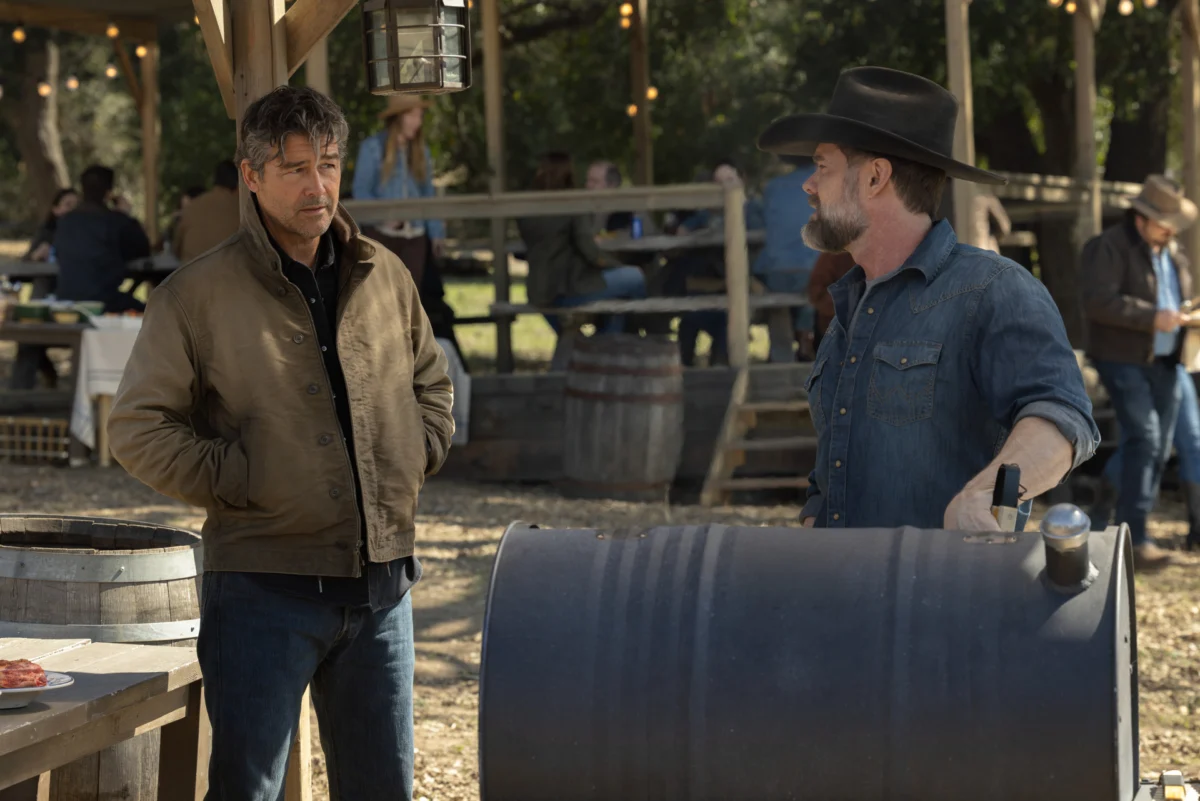
At its core, Lanterns pivots on the reluctant, friction-filled relationship between veteran Green Lantern Hal Jordan, played with weary bravado by Kyle Chandler, and his potential successor, John Stewart, brought to life with striking intensity by Aaron Pierre.

Summers established distinct visual parameters for the central pairing right away. Hal operates in a warmer, looser color temperature and silhouette, reflecting a man who has carried the weight of the universe for too long and grown comfortably indifferent. John, by contrast, is sharply tailored, svelte, and coolly contained.
Beyond the core duo, the wider canvas of Rushville required an intricate balancing act between small-town realism and high-concept science fiction. This is nowhere more apparent than in the stylistic choices surrounding Laura Linney’s sublimely strange alien character, Lianna.
"The idea was that she is trying to manifest into how she thinks an Earthly woman looks, but she’s sort of misstepped her time zone," Summers explained in an interview. "So we leaned into really beautiful silhouettes from the sort of late ’50s. Tippi Hedren in The Birds was a big reference for me, clearly, in one of her outfits. Pencil skirt with a swing coat kind of a thing. Always a scarf, always gloves."
Linney’s out-of-time aesthetic becomes even more pronounced in Episode 3, titled "OutKast," where she interacts with John and his mother, Bernadette (portrayed by Jasmine Cephas Jones), spanning decades of John’s demanding upbringing. While changing outfits helps denote the passage of time—such as a suspenseful sequence where Lianna orders John to stay put and vanishes until the next day—her steadfast adherence to a placid, Hitchcockian style makes her look increasingly eerie the closer the narrative creeps toward the present day.

Chronology of Production: From Mood Boards to Impromptu Fittings
The development of the series’ aesthetic was an organic, highly collaborative journey that took shape long before cameras rolled on set.
The Anthony Bourdain Inspiration for Hal Jordan
When Summers began building her initial mood board for Earth’s most cantankerous and world-weary member of the Green Lantern Corps, she bypassed traditional comic book panels for real-world inspiration. One of the foundational images featured late chef and author Anthony Bourdain.
"He’s sitting in some kind of cantina somewhere, and he’s just relaxed in the chair with his arm back and his other arm with a beer on the table and his legs crossed, and he’s wearing exactly what Hal is wearing for his hero 2016 look," Summers noted. "There was something about [Bourdain’s] gray hair, his demeanor, his take on the world, and his sad ending. It just rang true to me that that was Hal."
The L.A. Pre-Fitting Magic
It is rare for a costume designer to secure significant alignment time with lead actors during early prep phases. However, fate intervened when both Kyle Chandler and Aaron Pierre happened to be in Los Angeles while Summers was pulling looks. They organized an impromptu, pre-fitting meeting primarily dedicated to sharing character notes.

"It’s an incredible relationship that the two of them have, the love/hate thing, the sort of admiration for each other and the disdain for each other at the same time, and the camaraderie and the fear and the everything," Summers said. "And we found our pieces actually in that pre-fitting. That’s where we found [Hal’s] look. It was magic."
The Evolution of the Heartland Cowboy Aesthetic
Perhaps the most transformative styling choice on the series was the introduction of cowboy hats. Initially, Summers explored a standard ballcap, heartland aesthetic for the residents of Rushville, particularly focusing on ranching bigwig Mason (Garret Dillahunt) and skeptical Sheriff Kerry (Kelly Macdonald).
However, Summers prudently kept a selection of authentic Western gear on hand just in case.
"We didn’t wanna do anything super ranchy. We were sort of dummying down the looks as far as we could go and still be believable," Summers admitted. "And I was a bit sad about that, to be honest with you, because Garrett Dillahunt is so handsome, and he so can be a cowboy. And Kelly, being from Scotland, was so ready to wear some cowboy boots in town and so ready to do this whole thing."

Once the creative team witnessed Dillahunt and Macdonald test-driving the Western look, the decision was instantaneous. Photographs were sent to the upper-tier production team, whose response was definitive: It’s a cowboy hat show. The hats added a physical stature and subtle non-verbal acting tools—allowing actors to tip brims or cast side-eyes from the shadows—that elevated the performances.
Supporting Data & Visual Motifs: The Devil in the Details
In contemporary costume design, victories are measured in millimeters. Without the grand, billowing capes or ornate armor typical of high fantasy, contemporary pieces must speak volumes through micro-textures.
- The Avian Thread: Lianna’s connection to the Stewart family is coded directly into her wardrobe. "Every outfit she had on, somewhere in that outfit, whether it was in the scarf or a pin, there was a reference to a bird," Summers explained. "The bird connects her with Bernadette and with John. That was intentional." Whether incorporating physical feathers or hidden avian prints embedded into dress fabrics, Lianna’s obsession with John is sewn into every seam.
- Tailored Precision: Aaron Pierre’s John Stewart required an entirely different philosophy. "You can’t imagine putting anything on Aaron that’s kinda casual and hip," Summers said. "It just would never work. He’s close cut, very precisely cut." This precise tailoring mirrors John’s internal discipline and tragic evolution across different eras of his life.
- Generational Expansion: The design team tackled three generations of family members across multiple timelines. Episode 3 offered substantial opportunities for actors Jasmine Cephas Jones and Jay Alphonse to shine within authentic 1980s period styling, charting the foundational trauma and resilience of the Stewart household.
Official Responses and Creative Collaborations
The synergy between the actors and the wardrobe department proved essential to grounding the cosmic elements of the series in visceral human reality. By giving performers physical items they could actively utilize—from Chandler’s casual, beer-in-hand slouch to Macdonald’s commanding Sheriff footwear—the costumes transformed into literal extensions of the characters’ psychology.
Industry analysts have noted that Lanterns succeeds precisely because it treats its extraterrestrial elements as secondary to the intimate character dynamics unfolding in Nebraska. The wardrobe acts as a quiet mediator between the mundane and the impossible, ensuring that whether a character is wearing a 1950s swing coat or a faded rancher’s button-down, every thread serves the overarching narrative.

Implications for the Future of DC’s Television Slate
As Lanterns airs its gripping narrative arcs on HBO, the meticulous approach to costuming establishes a high-water mark for future installments within the broader DC television universe. By rejecting generic superhero tropes in favor of grounded, character-driven aesthetics, the production has proven that genre television can—and should—prioritize textile storytelling.
With further revelations, intergalactic conflicts, and generational reckonings promised before the season concludes, audiences can rest assured that more narrative tells remain masterfully hidden within the seams of the show’s wardrobe.
“Lanterns” is now streaming exclusively on HBO.
