
Trapped in the Porcelain Abyss: Dark Sky Films Unveils the Deranged Horror-Comedy ‘Flush’
By: Editorial Staff
October 2, 2026
In an era where the horror genre is increasingly defined by elevated psychological dread and prestige aesthetics, French filmmaker Grégory Morin has decided to take the opposite approach. With the unveiling of the official U.S. trailer for his latest feature, Flush, Morin invites audiences to descend into a claustrophobic, visceral, and undeniably grotesque nightmare that takes place almost entirely within the confines of a public restroom. Distributed by the genre-specialist powerhouse Dark Sky Films, the project is already being hailed as one of the most audacious and "bonkers" cinematic experiments of the year.
Main Facts: A Nightmare in a Bowl
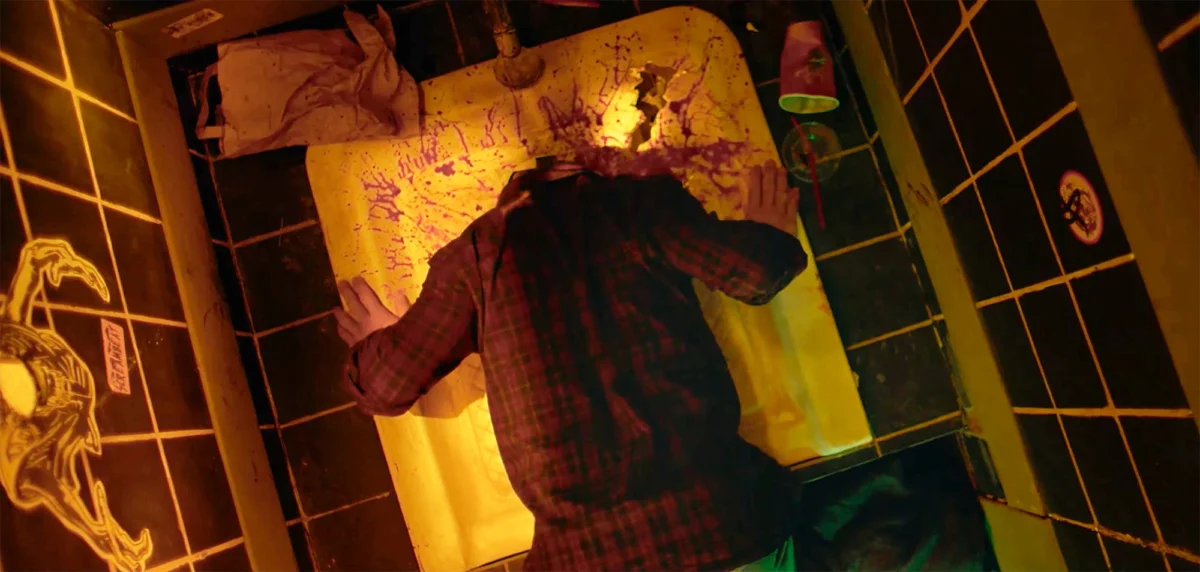
The premise of Flush is as simple as it is skin-crawling. The story follows Luc (R. Jonathan Lambert), a middle-aged cocaine addict whose desperate attempt to win back his ex-girlfriend in a seedy nightclub goes catastrophically wrong. After stumbling into the middle of a high-stakes drug deal, Luc finds himself abandoned and incapacitated.
The film’s central conceit is a masterclass in minimalist horror: Luc is left for dead with his head trapped firmly inside a squat toilet—the type of hole-in-the-ground facility found in older, less-than-sanitary establishments. What follows is a survivalist descent into madness. As the night progresses, Luc is forced to navigate a series of increasingly bizarre threats, ranging from menacing drug dealers returning to the scene of their crime to an encounter with a "junkie rat" that has made the plumbing its home.

The film is not merely a survival story; it is a dark, sardonic commentary on addiction, desperation, and the indignities of the human condition. By limiting the scope of the camera to the interior of a restroom, Morin forces the audience to experience the same sensory claustrophobia as his protagonist. It is, by all accounts, a film that thrives on "gnarly" practical effects and a relentless, high-octane pace.
A Chronological Descent: From Fantasia to VOD
The journey of Flush to the American market has been a slow-burn trajectory typical of high-concept international indie films.
- 2025 – The Festival Circuit: The film first emerged on the international radar at the 2025 Fantasia Film Festival. Known for championing experimental and boundary-pushing genre cinema, Fantasia provided the perfect incubation environment for Flush. Audiences were immediately struck by the film’s audacity, noting that it occupied a unique space between the surrealism of French extreme cinema and the black humor of indie cult classics.
- Late 2025 – Regional Distribution: Following its festival premiere, the film made limited appearances in European markets, garnering a reputation for being a "must-see for the brave." Its reputation as a conversation piece grew as word-of-mouth spread about its shocking imagery.
- October 2, 2026 – The U.S. Trailer Reveal: Dark Sky Films officially broke the silence regarding the U.S. release, dropping a trailer that highlights the chaotic, adrenaline-fueled nature of the film.
- October 9, 2026 – The Digital Release: Dark Sky Films has confirmed that Flush will be available via Video-On-Demand (VOD) in the United States, marking a wide release that aims to capture the attention of horror aficionados just in time for the Halloween season.
Supporting Data: The Anatomy of a Genre-Bender
To understand Flush, one must look at the pedigree of its creative team. Director Grégory Morin is no stranger to the fringes of the horror genre. Having previously directed Ultimate Zombie Feast and a series of gritty, visceral shorts, Morin has cultivated a specific aesthetic that values tactile, practical horror over clean-cut digital polish.
The screenplay, penned by David Neiss, relies heavily on the physical performance of R. Jonathan Lambert. Lambert’s performance as Luc is the anchor of the film; for the majority of the runtime, he is a face in a hole, relying on vocal performance and facial expressions to convey terror, desperation, and drug-addled confusion. The supporting cast—including Élodie Navarre, Elliot Jenicot, and Rémy Adriaens—serves to populate the outer world of the club, creating a sense of a world moving on without Luc, even as he faces his potential demise.

The production was handled by Kieran Clemow, Thomas Leterrier, and Jean-Michel Tari, who opted for a high-contrast, low-light aesthetic that emphasizes the grime and claustrophobia of the set. The production design is a critical character in its own right, turning a functional, utilitarian space into a trap that feels increasingly sentient and hostile.
Official Responses and Industry Reception
The initial reception to the trailer has been one of polarized fascination. On social media platforms and film forums, the comparison to the "Worst Toilet in Scotland" scene from Danny Boyle’s Trainspotting has been ubiquitous. However, where that scene served as a momentary peak of drug-induced surrealism, Flush promises to sustain that level of intensity for the duration of its runtime.
Dark Sky Films, which has a long history of distributing films that challenge conventional taste (such as the House of the Devil or the Hatchet series), clearly views Flush as a cult classic in the making. In a brief statement accompanying the trailer release, the studio noted: "Some films are made to be comfortable; others are made to be visceral. Flush is an experience that will stay with you—if only because you’ll never look at a public restroom the same way again."
Critics who caught the film at Fantasia have described it as a "sensory assault," praising the film’s ability to maintain tension despite the severe physical limitations of the protagonist. While some reviewers have cautioned that the film is "not for the faint of heart" or those with "weak stomachs," the consensus is that Morin has achieved something rare in 2026: a film that feels genuinely unclassifiable.

Implications: The Future of "Micro-Location" Horror
The release of Flush signals an interesting trend in low-budget, high-concept filmmaking. As the costs of traditional horror filmmaking—which often relies on expansive sets, heavy CGI, or extensive location shooting—continue to fluctuate, directors are increasingly turning to "micro-location" narratives.
By confining the action to a single, small space, filmmakers like Morin are able to maximize their production budget on lighting, practical makeup effects, and high-fidelity sound design. This shift has significant implications for the independent horror market:
- Practical Effects Renaissance: By forcing the camera into tight, confined spaces, Flush relies on the tactile nature of practical effects. This serves as a rebuttal to the "clean" look of digital effects, appealing to a growing demographic of horror fans who crave the grit and "nastiness" of 80s and 90s genre cinema.
- Narrative Focus: A film set in a single location demands a tighter script. Writers are forced to rely on dialogue, pacing, and performance rather than set-pieces. In Flush, every movement of a rat, every sound of a door opening, and every distant muffled shout becomes a major plot point.
- The VOD Advantage: Films like Flush are uniquely suited for the VOD model. They function well as "event" viewing for niche audiences who gather in digital spaces to discuss the most shocking scenes. The "gross-out" factor serves as a powerful marketing tool in the digital age, encouraging viewers to share clips and discuss the film’s most intense moments on social media.
As we approach the October 9th release date, the buzz surrounding Flush serves as a reminder that the horror genre remains the most vital playground for cinematic experimentation. Whether or not Flush succeeds as a masterpiece or goes down in history as a piece of "splatter-comedy" infamy remains to be seen. However, one thing is certain: Grégory Morin has successfully created a film that is impossible to ignore. For those seeking a cinematic experience that is daring, disgusting, and undeniably creative, the doors to the club bathroom are wide open.
Prepare for a night in the depths—just make sure you aren’t eating while you watch.
