Empowering the Rise of Niche Sports: How Bantaray Mobile Production Scales Live Broadcasts with AJA Gear
Main Facts
In the rapidly evolving landscape of sports broadcasting, the massive surge in popularity for niche sports—ranging from competitive pickleball and track-and-field events to minor league hockey—has created unique logistical hurdles for production crews. While major league broadcasts operate with vast budgets, dedicated miles of cable runs, and large technical teams, independent mobile production companies often face the exact same technical obstacles with a fraction of the crew and resources.
Enter Steve Banta, founder of California-based Bantaray Mobile Sports Production, and freelance camera operator Jeff Highbaugh. Since its inception in 2009, Bantaray has specialized in delivering high-quality broadcasts for non-traditional and regional sporting events, including high school sports broadcasts for Spectrum across Orange County and Riverside, and production support for the Coachella Valley Firebirds.
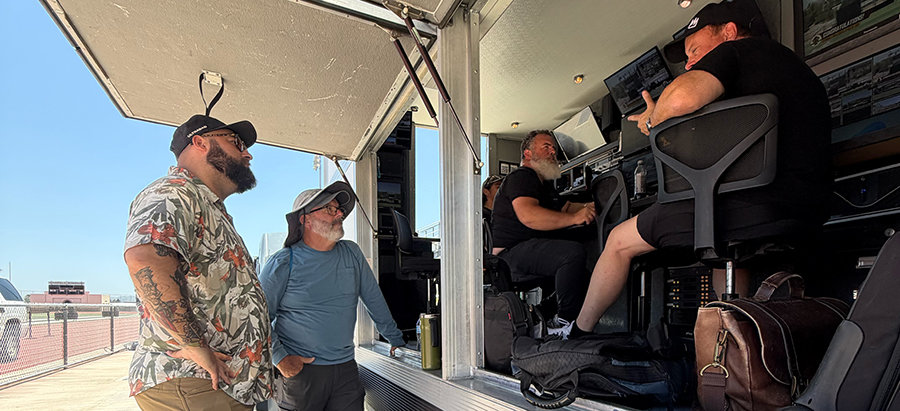
To overcome the immense challenge of transporting uncompressed, pristine video and audio signals over vast distances across unpredictable outdoor and indoor venues, Bantaray relies heavily on a robust, field-tested infrastructure built around AJA Video Systems hardware. Specifically, the company deploys an arsenal of 24 AJA FiDO Mini-Converters, alongside a suite of SDI/HDMI converters, distribution amplifiers, and AJA Ki Pro recorders. This hardware pipeline allows Bantaray’s lean crew to bridge the gap between OB (Outside Broadcast) trucks, commentator booths, and in-venue LED scoreboards without sacrificing signal integrity, even when operating in extreme weather conditions.
Chronology
2009: The Foundation and Early Evolution
Bantaray Mobile Sports Production was founded in 2009 with a clear vision: to bring professional-grade mobile production capabilities to regional, niche, and high school sporting events that traditionally lacked high-end broadcast coverage. In the early years, the company focused on establishing a repeatable, reliable mobile workflow capable of adapting to various community sports venues that lacked dedicated broadcast infrastructure.
The Remote Production Pivot
As digital streaming platforms democratized content distribution, audience demand for niche sports exploded. Bantaray continuously refined its mobile production pipeline to keep pace. However, the operational paradigm shifted dramatically following the global disruptions of the early 2020s. The industry-wide push toward remote workflows, decentralized setups, and agile multi-camera deployment forced Bantaray to upgrade its signal transport capabilities. The company standardized its fiber-optic infrastructure, leaning heavily on AJA FiDO Mini-Converters to streamline long-distance cabling without expanding crew sizes.
Present Day: Scaling Multi-Camera Productions and Arena Entertainment
Today, Bantaray manages an extensive portfolio of live events. Beyond high school athletics and regional hockey, the company is actively expanding its footprint into major entertainment and concert broadcast setups, such as outfitting the production infrastructure for Acrisure Arena in Thousand Palms, California. By scaling their equipment inventory—now boasting 24 AJA FiDO units—Bantaray continues to push the boundaries of what a lean mobile production unit can achieve in live broadcasting.
Supporting Data & Technical Workflow
Executing a professional live sports broadcast with a lean crew requires ruthless efficiency. Because scouting a venue beforehand is rarely an option, Bantaray’s team relies on digital reconnaissance tools like Google Earth before arriving on site to map out OB truck parking and cable runs.
The Power of Fiber-Optic Transport
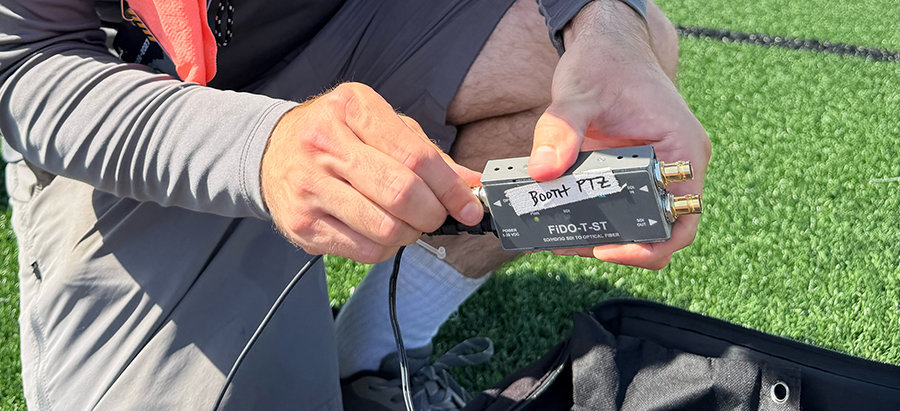
Traditional copper-based SDI cabling has distinct limitations regarding distance, weight, and signal degradation. Bantaray solves this by utilizing tactical fiber-optic cable runs paired with AJA FiDO Mini-Converters (available in single, dual, and quad-channel configurations).
Distance Capabilities: Bantaray’s longest individual fiber reel spans 1,000 feet. By utilizing FiDO converters on both ends, the team can seamlessly "barrel" multiple fiber reels together to span thousands of feet across sprawling sports complexes without signal loss or power limitations.
Multi-Camera Efficiency: Using a four-pair tactical fiber-optic cable, the team can multiplex up to four distinct camera signals down a single fiber line. As freelance operator Jeff Highbaugh notes, "The setup is so fast, and we can run four cameras down one fiber line."
The Booth Kit Ecosystem: Bantaray houses its AJA FiDO units inside a custom portable booth kit complete with an integrated I/O panel and audio gear. Multiple cameras positioned around the commentator booth feed SDI signals into the kit, where they are instantly converted to fiber and beamed back to the production truck.
Comprehensive AJA Integration
Beyond the FiDO series, Bantaray’s workflow integrates multiple facets of the AJA ecosystem:
Signal Conversion & Monitoring: AJA Mini-Converters are deployed to transform SDI feeds into HDMI for local monitoring and distribution.
Signal Management: Distribution amplifiers ensure clean signal routing throughout the mobile production truck.
Capture: AJA Ki Pro recorders handle mission-critical signal capture, ensuring stable archival files of every live event.
Audio Interoperability: The video transport infrastructure works in tandem with Dante audio systems, creating a synchronized, low-latency audio-visual pipeline.
Official Responses & Industry Insights
The reliance on high-grade professional equipment is a philosophy deeply embedded in Bantaray’s operational ethos. Equipment failure during a live broadcast is entirely unacceptable.
Founder Steve Banta emphasizes the financial and operational wisdom of investing in professional-grade hardware from the outset:
"Every event is different, and each venue presents unique challenges. Sending signals across long distances is almost always a hurdle. We have to find simple ways to get reporter feeds back to the truck, send program feeds to in-venue LED displays, and route audio and video signals safely across the venue. Our AJA FiDO Mini-Converters support these needs and have been incredibly dependable through rain, extreme heat, and constant travel—they just keep working."
Banta adds that the psychological and professional impact of deploying recognized broadcast gear should not be underestimated:
"Reliability is everything in live production. When crews see professional gear like AJA on site, they know you’re top-notch. It’s better to invest in reliable equipment once than to frequently have to troubleshoot cheaper alternatives."
Freelance camera operator Jeff Highbaugh, who operates directly within the demanding elements of live sports production, echoes this sentiment regarding field durability:
"We’ve put our FiDOs through just about every weather condition imaginable, and they’ve never let us down. That reliability gives everyone confidence because we know the gear will simply do its job. We don’t have a giant crew, and everyone is wearing multiple hats. So, we need gear that is reliable, consistent, and easy to use."
Implications and Future Outlook
The success of Bantaray Mobile Sports Production highlights a broader transformation within the broadcast industry. As streaming services and dedicated digital platforms continue to democratize sports consumption, the appetite for regional, niche, and high school sports will only accelerate. Production companies can no longer rely on massive, traditional OB infrastructure to turn a profit on lower-margin, high-frequency events; instead, agility, speed, and absolute reliability are the new currencies of success.
Looking toward the horizon, Bantaray is keeping a close eye on emerging broadcast topologies. While the broader tech sector remains fixated on generative artificial intelligence, Bantaray is heavily invested in the evolution of remote workflows and advanced IP production standards, such as SMPTE ST 2110.
Reflecting on the future of live event streaming, Highbaugh concludes:
"Streaming continues to grow, so I’m looking at technology that can help me send high-quality, low-latency signals efficiently. Whether we’re working with limited bandwidth or remote locations, finding reliable ways to get content on the air remains a major priority."
Ultimately, the partnership between forward-thinking mobile production outfits like Bantaray and enterprise-grade hardware manufacturers like AJA proves that high-end broadcast quality is no longer exclusive to major media networks—it is rapidly becoming the gold standard for every corner of the live sports ecosystem.