
A Cinema of Attention: Documenting the Six-Decade Avant-Garde Odyssey of Nathaniel Dorsky and Jerome Hiler
For more than sixty years, filmmakers Nathaniel Dorsky and Jerome Hiler have quietly operated at the absolute vanguard of experimental cinema. Working exclusively in the tactile, light-sensitive medium of silent 16mm film, the pair have forged an artistic and devotional practice that treats the projector beam not merely as a tool for storytelling, but as an instrument for psychological and spiritual awakening.
Despite their towering status within the global avant-garde community—culminating in major retrospectives at institutions like the Museum of Modern Art (MoMA)—their profound contributions have largely remained outside the mainstream cultural lexicon. That is about to change.
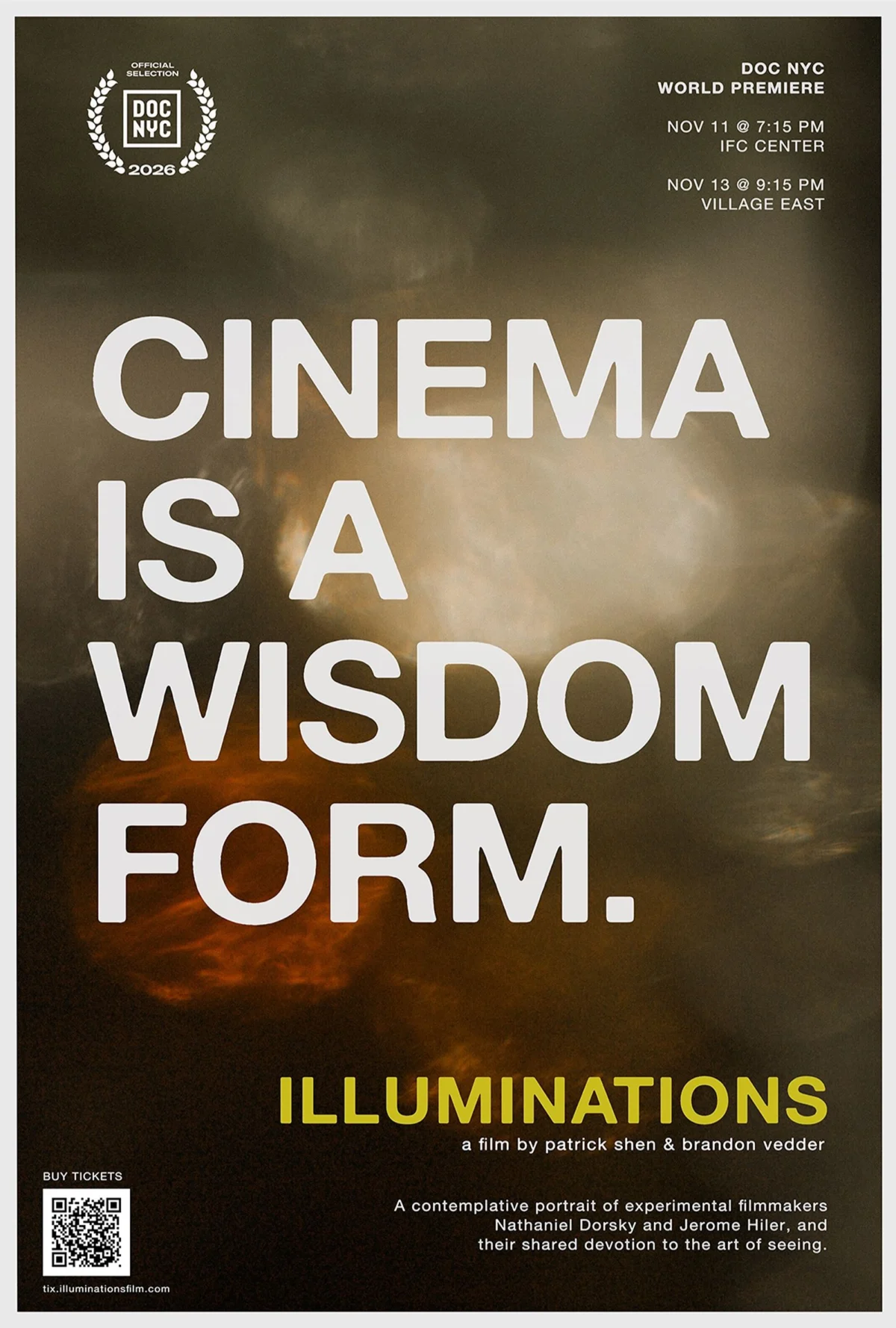
Directors Patrick Shen and Brandon Vedder have turned their contemplative lenses toward these two elusive pioneers in a new documentary, Illuminations. Ahead of the film’s high-profile world premiere at the DOC NYC festival, the official trailer has been released, offering audiences a rare glimpse into a shared life dedicated entirely to the elevation of light, perception, and presence.
Main Facts: Unveiling Illuminations and Its Subjects
At its core, Illuminations is both a biographical portrait and a philosophical inquiry. Directed by Shen and Vedder, the documentary captures the intertwined lives and parallel careers of Nathaniel Dorsky and Jerome Hiler. Working for over six decades without commercial compromise, the pair have championed a minimalist, highly contemplative form of filmmaking that stands in stark opposition to the narrative-heavy, digital saturation of modern media.
The documentary’s festival run kicks off with its world premiere at DOC NYC, with screenings scheduled for November 11 at the IFC Center and November 13 at the Village East by Angelika. Following the premiere, New York’s legendary Anthology Film Archives will host a special three-program retrospective dedicated to Dorsky and Hiler’s work from November 16–18. True to the artists’ lifelong aesthetic purity, these screenings will be presented exclusively on 16mm film.
The central thesis of Illuminations—and of Dorsky and Hiler’s entire body of work—interrogates the ultimate capability of the medium. As the official synopsis asks: Can cinema become not simply an art form, but a wisdom form—a way of teaching us how to see?
Chronology: From the 1960s Underground to Museum Retrospectives
To understand the weight of Illuminations, one must trace the historical trajectory of Dorsky and Hiler, a journey that mirrors the evolution of American experimental cinema itself.
The Underground Beginnings (1960s)
Dorsky and Hiler emerged during the vibrant, tumultuous underground film culture of 1960s New York and San Francisco. This era was defined by a rejection of Hollywood conventions, with artists utilizing lightweight 16mm equipment to explore personal vision, countercultural politics, and formal abstraction. While many of their peers gravitated toward aggressive political manifestos or psychedelic collages, Dorsky and Hiler pursued a quieter, more devotional path. Their early years were characterized by a fierce independence, operating largely in the shadows of the commercial film industry.
Decades of Private Practice and Refinement
Through the 1970s, 80s, and 90s, the duo maintained a rigorous, often solitary routine. While Hiler balanced his filmmaking with a celebrated career as a stained-glass artist, Dorsky honed a cinematic style dependent on polyphonic editing and extreme sensitivity to natural light. For decades, their films were experienced primarily through intimate, private screenings for fellow artists, scholars, and devoted cinephiles. This monastic dedication allowed them to perfect an aesthetic free from the pressures of box-office expectations or institutional funding cycles.

Institutional Recognition and the Modern Era
In recent years, the art world has caught up to what the underground has known for decades. Dorsky and Hiler have been the subjects of major retrospectives and sold-out programs at some of the world’s most prestigious cultural institutions, most notably the Museum of Modern Art in New York. Illuminations captures this late-career renaissance, bridging the gap between their reclusive, countercultural origins and their current status as revered elder statesmen of visual poetry.
Supporting Data: The Philosophy of the "Wisdom Form"
What distinguishes Dorsky and Hiler’s filmography is their steadfast commitment to silent 16mm stock. In an era where celluloid has been almost entirely supplanted by digital sensors and algorithms, their continued reliance on physical film is an artistic statement in itself.
- The Medium is the Material: By utilizing 16mm, Dorsky and Hiler honor the physical grain, organic degradation, and chemical history of light passing through emulsion. The materiality of the film stock mirrors the fragility of human memory and perception.
- Cinema as Perception: Dorsky’s theoretical writings—most notably his foundational book Devotional Cinema—argue that movies should bypass linear storytelling to trigger a pre-verbal, meditative state in the viewer. His films use subtle shifts in focus, framing, and pacing to make the audience acutely aware of their own act of seeing.
- The Interplay of Light and Shadow: Hiler’s contributions, often blending his deep understanding of optics, color, and his background in stained glass, introduce a transcendent dimensionality to the screen. Together, their works function as visual liturgy.
Official Responses and Industry Anticipation
The announcement of Illuminations and its subsequent selection at DOC NYC has generated considerable excitement within the global film community. Critics, curators, and avant-garde enthusiasts have long awaited a definitive cinematic document that honors the pair’s legacy.
Festival programmers and archival institutions have praised Shen and Vedder for tackling a subject that resists conventional documentary framing. Because Dorsky and Hiler’s work is intentionally non-narrative and wordless, capturing their essence requires a visual language that matches their own. Early industry buzz suggests that Illuminations succeeds by adopting a similarly contemplative rhythm, allowing viewers to breathe with the artists rather than simply absorbing biographical trivia.
Furthermore, the collaboration with Anthology Film Archives for a dedicated three-day, 16mm-only screening series underscores the institutional weight behind the documentary’s release. Anthology has long been a sanctuary for independent and experimental film, making it the ideal venue to experience Dorsky and Hiler’s work in its intended physical format.
Implications: Why Dorsky, Hiler, and Illuminations Matter Today
The arrival of Illuminations is timely, carrying deep implications for how contemporary audiences consume and value visual media.
An Antidote to Digital Saturation
In the twenty-first century, humanity is inundated with an unprecedented volume of moving images. Social media feeds, streaming algorithms, and hyper-edited blockbusters bombard the human sensorium, conditioning viewers to expect rapid cuts and constant stimulation. Dorsky and Hiler’s cinema offers a radical antidote. By demanding absolute stillness, patience, and deep attention, their work trains the human eye to find extraordinary beauty in the ordinary—a passing shadow, the texture of a brick wall, the way sunlight filters through leaves.
Preserving the Avant-Garde Lineage
As the generation of artists who birthed the 1960s American avant-garde steadily ages, the task of preserving their philosophy and history becomes urgent. Illuminations does not merely record two biographies; it acts as a cultural repository for an endangered way of thinking about art. It reminds younger generations of filmmakers that cinema can exist independently of commerce, celebrity, and narrative structure.
Redefining Cinematic Purpose
Ultimately, Illuminations forces a re-evaluation of what movies are capable of achieving. If, as Dorsky suggests, cinema can truly function as a "wisdom form," then the projector becomes a modern hearth around which we gather not to be told a story, but to learn how to inhabit our own perception more fully. As audiences sit in the dark of the IFC Center, Village East, and Anthology Film Archives this November, they will not just be watching a movie about two legendary artists—they will be invited to share in their quiet, revolutionary vision of the world.
