
A Tale of Two Halves: Why Kitao Sakurai’s ‘Street Fighter’ Fails to Land the Knockout Blow
The history of video game adaptations is littered with noble failures and misguided attempts to translate digital mechanics into cinematic storytelling. When director Kitao Sakurai announced his take on the legendary Street Fighter franchise, there was a palpable sense of cautious optimism. Early marketing promised a stylized, nostalgic, and high-octane spectacle that honored the source material while embracing the absurdity of its roster. Yet, the final product is a confounding, disjointed experience—a film that manages to be both a visual triumph and a narrative catastrophe, collapsing under the weight of its own ambition.
The Premise: A Stylish Start
The film’s opening act is, by almost any metric, a masterstroke of adaptation. Utilizing the animation prowess of Titmouse Inc., Sakurai frames the lore through vibrant, 2D anime-inspired sequences. This visual shorthand effectively establishes the history of Ken (Noah Centineo) and Ryu (Andrew Koji), two best friends training under the stoic sensei Gouken (Don Lee). By leaning into the aesthetic roots of the franchise, the film provides a compelling, mythological backdrop: Ryu’s victory in the 1987 World Warrior tournament, the subsequent corruption of his spirit, and the looming, demonic threat of Akuma (portrayed with imposing physicality by WWE’s Roman Reigns).
As the film transitions into live-action, it adopts a self-aware, irreverent tone. Through stylized MTV-esque montages, we witness Ken’s descent into reckless celebrity and Ryu’s self-imposed exile. The chemistry between the leads is anchored by the addition of Andrew Schulz as Dan Hibiki, Ken’s opportunistic manager—a performance that serves as the film’s soulful, comedic anchor. When secret Interpol agent Chun-Li (Callina Liang) recruits the duo for a revived tournament hosted by the fascist despot M. Bison (David Dastmalchian), the stage is set for a high-stakes, action-heavy ensemble piece.
Chronology of a Collapse
The film’s decline is not gradual; it is structural. The narrative rhythm is surprisingly tight until the halfway mark—the moment the tournament begins. The audience is promised a seven-fight elimination series, but Sakurai’s pacing disintegrates almost immediately. We are treated to barely one and a half matches before the plot splinters into a series of disconnected vignettes.
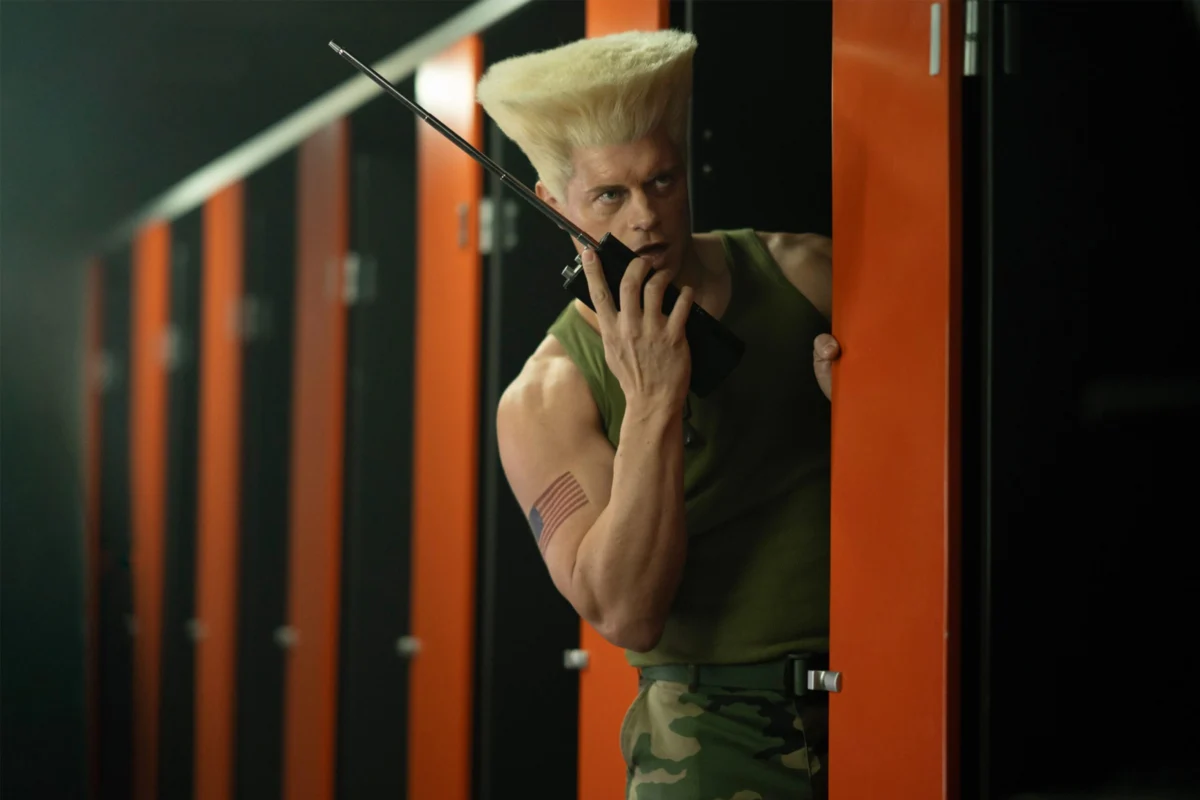
The first hour establishes a clear through-line: the tension between Ken’s desire for glory and Ryu’s apprehension regarding the tournament’s true purpose. However, once the characters check into M. Bison’s gilded, fortress-like hotel, the film abandons its character arcs in favor of rapid-fire cameos and stunt casting. The roster of fighters is impressive—featuring Jason Momoa as the green-skinned Blanka, Orville Peck as the enigmatic Vega, 50 Cent as the pugilistic Balrog, and Cody Rhodes as Guile—but their inclusion feels less like a narrative necessity and more like a collection of trading cards slapped onto a crumbling foundation.
By the final act, the story ceases to function. Vital information regarding the characters’ energy abilities is relegated to late-stage flashbacks, while the central antagonists, M. Bison and Akuma, spend the duration of the tournament waiting in the wings, entirely unaware of one another’s machinations. The film concludes not with a climactic resolution, but with a petering out of momentum that leaves major plot threads—specifically Chun-Li’s vendetta against Bison—hanging in the air.
Supporting Data: The Production Failure
The technical deficiencies in the film’s latter half suggest a production plagued by interference or significant post-production restructuring. Reports indicate a chaotic ADR process, with much of the dialogue obscured by an aggressive, thundering sound mix that frequently renders characters inaudible. When dialogue is audible, it is often shot from behind or with the speaker’s mouth obscured, a telltale sign of heavy re-writes and ADR patching.
The tonal inconsistency is further exacerbated by the integration of improvisational comedy that rarely lands. Eric André, a longtime collaborator of Sakurai, appears in a role that feels grafted onto the film, serving as a jarring distraction from the heightened stakes of the martial arts tournament. Furthermore, the film’s reliance on fan service becomes its undoing. While homages to Street Fighter II: The Animated Movie are initially charming, they often feel hollow. A notable example is the replication of the iconic "shower scene" featuring Chun-Li; while the original animated sequence served to build tension for a fight, the live-action iteration feels voyeuristic and detached, serving no purpose other than to leer at the performer.
Official Responses and Creative Direction
While the studio has remained largely silent regarding the production struggles, the creative choices—particularly the "retrograde" depiction of female characters and the use of offensive tropes regarding Guile’s sexuality—have drawn sharp criticism. These elements suggest a lack of cohesion in the film’s core philosophy. The film is clearly a work at war with itself: it wants to be a gritty martial arts epic, a slapstick comedy, and a faithful anime homage all at once. By refusing to commit to a singular tone, it fails to achieve any of them.
The casting of pro-wrestlers is a testament to the film’s "fighting as a language" approach, but even this becomes a crutch. In a world where fisticuffs replace dialogue, character development is sacrificed. We learn almost nothing about the motivations of secondary characters like Dhalsim (Vidyut Jammwal) or Vega; they are merely obstacles in a video game level, not human beings inhabiting a narrative.
Implications for Future Adaptations
The failure of this Street Fighter adaptation carries a significant lesson for Hollywood: aesthetic accuracy is not a substitute for narrative structure. The film is a cautionary tale regarding the "multiverse" or "ensemble" style of storytelling. By attempting to pack too many legacy characters into a single, two-hour runtime, the director lost sight of the fundamental rules of cinema.
The tragedy of this project is that the potential was clearly there. The hand-drawn flashbacks demonstrate a genuine love for the source material and a unique visual language that could have supported an entire film. Instead, the audience is left with a product that feels like a highlight reel of a much better movie that never existed.
As the industry continues to mine gaming history for IP, this Street Fighter will likely be remembered as a missed opportunity. It provides a blueprint for what to avoid: the neglect of character-driven stakes in favor of shallow fan service and the abandonment of narrative logic for the sake of pacing. Ultimately, the film stands as a testament to the fact that while a video game can thrive on endless rounds of combat, a movie requires a reason for the punches to matter. Without that, you aren’t watching a story—you’re just watching the timer run out.
