
Artistic Defiance: Singapore International Film Festival Defends ‘The Assassin(s)’ Amid Political Firestorm
By [Your Name/Journalistic Staff]
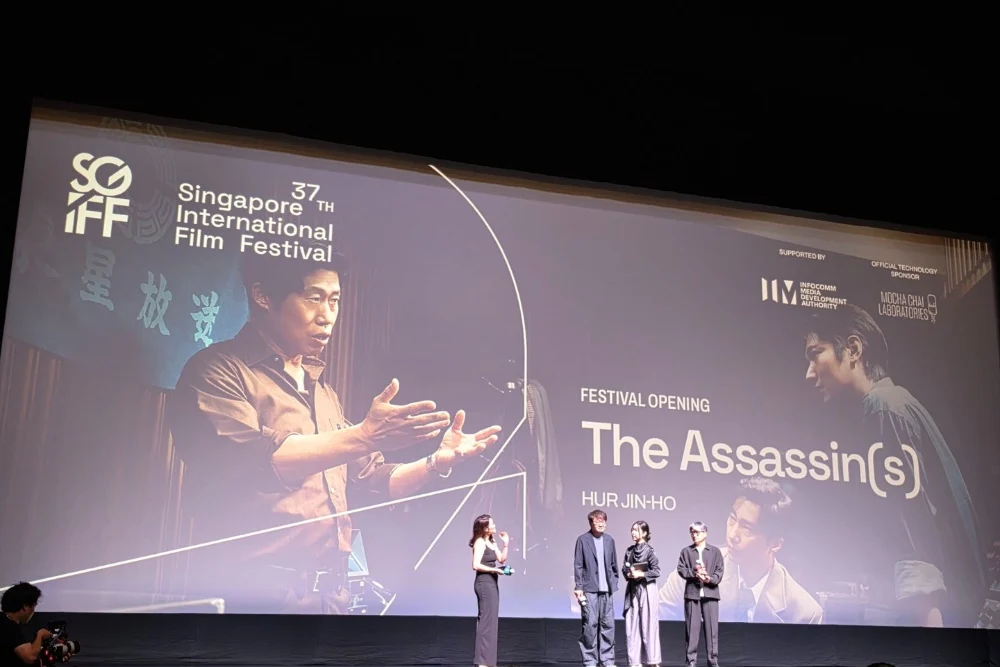
The 37th edition of the Singapore International Film Festival (SGIFF) opened on Wednesday with a defiant statement that echoed far beyond the walls of the Sands Theatre at Marina Bay Sands. As the smoke haze from regional forest fires finally began to lift, a different kind of tension—one born of South Korean political volatility—was held at bay by the festival’s steadfast commitment to creative autonomy.
The opening gala featured the international premiere of The Assassin(s), a high-stakes political thriller by acclaimed South Korean director Hur Jin-ho. The screening arrived in Singapore under a cloud of controversy, having faced an aggressive campaign by South Korea’s conservative opposition to block its exhibition. By standing by the film, SGIFF has solidified its reputation as a sanctuary for artistic integrity in an increasingly polarized geopolitical landscape.
A Standoff of Principles: The Opening Night
As the final credits of The Assassin(s) rolled, an emotional Hur Jin-ho addressed the capacity audience. His gratitude was palpable, directed squarely at the festival organizers who refused to buckle under mounting pressure.
"I am truly grateful to the film festival for protecting artistic freedom and the freedom of expression in cinema," Hur remarked. "I believe this decision by the festival will give great courage to those of us who made this film, including myself, the staff, and the actors."
The sentiment was echoed by SGIFF Chair Boo Junfeng, a filmmaker renowned for his own uncompromising work, including Sandcastle and Apprentice. Addressing the audience, Boo revealed that the festival had been inundated with messages demanding the film’s cancellation.
"SGIFF has carefully considered the various arguments put forth, and we see the film as an artistic interpretation of historical events," Boo stated. "We respect the creative vision of the makers behind it. Therefore, we stand by our decision to have the film as our opening."
Boo further clarified the festival’s institutional stance, emphasizing a strict "no-cut" policy. "We refuse to show anything that has been censored, because we believe films should be seen as their makers had intended, and nothing should alter their vision. It is not always easy to remain steadfast in the face of pressure, but I suppose choosing the path of least resistance isn’t quite in our DNA."
Chronology of the Controversy
The friction surrounding The Assassin(s) did not emerge overnight; it is the culmination of a deep-seated struggle over the narrative of South Korea’s authoritarian past.
- September 23, 2026: The Assassin(s) premieres in South Korea, immediately drawing the ire of conservative groups.
- Late September 2026: Tensions escalate as the Busan International Film Festival cancels a scheduled career talk with the film’s star, Lee Min-ho. Distributor Hive Media Corp. pulls the cast and crew from public appearances at the festival, citing credible safety concerns.
- Early October 2026: A conservative activist group begins picketing the home of lead actor Yoo Hae-jin. Simultaneously, a former Seoul city councilor from the People Power Party (PPP) files a request for a police investigation into director Hur Jin-ho and producer Kim Won-kuk on charges of defamation.
- October 6, 2026: The PPP sends a formal letter to SGIFF executive director Jeremy Chua, signed by all 109 of its lawmakers, demanding the festival pull the film from its lineup.
- October 7, 2026: SGIFF issues a formal statement refusing the demand, citing an "independent curatorial process" and the film’s "artistic merit."
- Late October 2026: The film arrives at the SGIFF, marking its international debut amidst international scrutiny.
The Historical Crucible: The 1974 Assassination
At the heart of the controversy is the film’s depiction of the August 15, 1974, shooting of First Lady Yuk Young-soo, wife of then-President Park Chung-hee. The event, which occurred during a Liberation Day ceremony at the National Theater, remains one of the most sensitive chapters in South Korean history.
In the official historical account, gunman Mun Se-gwang was identified as the sole perpetrator, acting on behalf of North Korea and the pro-Pyongyang organization Chongryon. Hur’s film, however, utilizes the format of a fast-paced political thriller to revisit the investigation, led by a fictionalized police inspector played by Yoo Hae-jin.
The film intentionally stops short of naming a definitive culprit, instead weaving a narrative of systemic obfuscation and institutional suspicion. It is this ambiguity that has triggered the backlash. Critics, including the PPP and foundations linked to the late Park family, argue that the film distorts historical facts to implicate the former government in its own tragedy. A survey cited by the PPP claimed that 58.2% of respondents viewed the film as a historical distortion.
In response, the film’s producers issued a firm rebuttal: "Nowhere in the film is any specific individual defined as being behind the incident, and the film’s hypotheses and dramatic settings are not presented as historical fact."
The Director’s Perspective: Human Nature and Historical Memory
For Hur Jin-ho, the project is a deeply personal endeavor. During his appearance in Singapore, he recalled being in the fifth grade when the 1974 shooting took place. "There were discrepancies between what was officially announced at the time and the actual facts that came to light later on," he explained. "I wanted to craft that aspect into a pursuit thriller format."
Producer Kim Won-kuk, who has collaborated with Hur on four films, praised the director’s obsession with the nuance of human experience. "Whenever we work together, he is a director who places immense value on details—details regarding human nature as well as the details of the incidents," Kim noted.
The presence of industry luminaries such as Indian director Aamir Khan and Hong Kong auteur Peter Chan Ho-sun at the premiere provided a silent but powerful show of solidarity for the artistic community, underscoring the global importance of the SGIFF’s decision to protect the director’s vision.
The Broader Implications for Asian Cinema
The battle over The Assassin(s) serves as a microcosm for the challenges currently facing Asian filmmakers. As governments and political entities increasingly seek to sanitize historical narratives, the role of international film festivals as neutral arbiters of art becomes critical.
The decision by SGIFF to host the film has set a precedent for other regional festivals. By refusing to capitulate to the demands of a foreign political party, the festival has reinforced the concept that cinema is a space for inquiry rather than a tool for historical revisionism.
Furthermore, the support from the Directors Guild of Korea and the Producers Guild of Korea, who have condemned the targeting of the film’s creators, suggests that the industry is beginning to coalesce around the principle of intellectual independence. The fight for The Assassin(s) is no longer just about a specific film or a specific historical event; it is about the right of artists to explore the "darkest chapters" of their own history without the fear of state-sanctioned censorship or political retribution.
As the SGIFF continues through November 1, the impact of this opening night will likely resonate through future festival circuits. For Hur Jin-ho, the experience has been a harrowing test of his professional resolve, but one that has ultimately validated his belief in the power of cinema to provoke, question, and endure. In the words of Boo Junfeng, the festival’s choice to stand firm ensures that the legacy of its founders remains intact: a commitment to the "direct link between a filmmaker’s vision and a paying audience," protected from the shifting tides of political convenience.
