
Breaking the Mold: The Evolution, Impact, and Scarcity of PG-13 Animation in American Cinema
By Vincent Alexander
Published: October 21, 2026
The announcement that Laika’s upcoming stop-motion fantasy epic, Wildwood, has secured an official PG-13 rating has sent a wave of excitement through the animation community. While the milestone is being celebrated by cinephiles and industry insiders alike, it also shines a harsh spotlight on a persistent structural gap in Hollywood: the extreme rarity of American animated features that target the transitional demographic between young children and mature adults.
For decades, the domestic commercial animation landscape has operated as a binary system. Features almost universally land in the G or PG category, designed to capture the widest possible family audience. When projects manage to break out of these kid-friendly confines, they typically bypass PG-13 entirely, venturing straight into R-rated territory.
The arrival of Wildwood provides a compelling pretext to examine the historical misfits, turbulent studio interventions, and cultural implications that define the elusive ecosystem of PG-13 animation.
From the Hays Code to Indiana Jones: The Birth of a Rating
To understand why PG-13 animation is such an anomaly, one must examine the history of the Motion Picture Association (MPA)—formerly the MPAA—rating system. Established in 1968 to replace the restrictive, censorship-heavy Hays Code, the ratings initially featured only G, PG, R, and X designations.
During the pre-PG-13 era of the late 1970s and early 1980s, several boundary-pushing animated features squeaked by with a standard PG rating despite containing content that would automatically trigger a PG-13 or higher today. Ralph Bakshi’s 1977 fantasy Wizards featured blood, profanity, revealing character designs, and post-apocalyptic neo-Nazi imagery. Martin Rosen’s 1978 adaptation of Watership Down subjected audiences to hyper-violent, spectacularly gory rabbit deaths. Meanwhile, 1983’s Rock & Rule packed in drug use, nudity, salty language, and an explicit portal to hell—all under a lax PG umbrella.
The cultural reckoning that birthed the PG-13 rating arrived in the summer of 1984, courtesy of two live-action blockbusters: Indiana Jones and the Temple of Doom and Gremlins. Both received PG ratings despite featuring visceral scares, including human sacrifice, a heart ripped straight from a chest, and a creature violently detonated in a microwave.
Faced with public outcry from traumatized parents, director Steven Spielberg—who helmed Temple of Doom and executive produced Gremlins—approached MPA officials to propose an intermediate buffer between PG and R. Thus, the PG-13 rating was born in July 1984.
Even after the designation was codified, early PG boundaries remained porous. Late-1980s comedies like Spaceballs, Beetlejuice, and Big famously dropped the F-bomb, while the live-action/animation hybrid Who Framed Roger Rabbit (1988) tested the limits of what a family-marketed film could get away with.
Chronology of the PG-13 Animated Feature
Pinpointing the exact first PG-13 animated feature is complicated by retroactive ratings and shifting distribution strategies.
The Precursors and Retrospective Ratings
Many online sources credit Martin Rosen’s The Plague Dogs (1982)—a bleak, harrowing tale of two canines escaping a government research lab—as the first PG-13 animated film. However, historical records indicate the film was not submitted for an MPAA rating during its brief U.S. theatrical run in 1985. (Notably, New York Times critic Janet Maslin reviewed it under the assumption it was rated PG). It did not officially receive a PG-13 rating until its 2004 DVD release, ensuring generations of unsuspecting viewers were scarred by its unremitting despair.
The Live-Action/Animation Hybrids of the 1990s
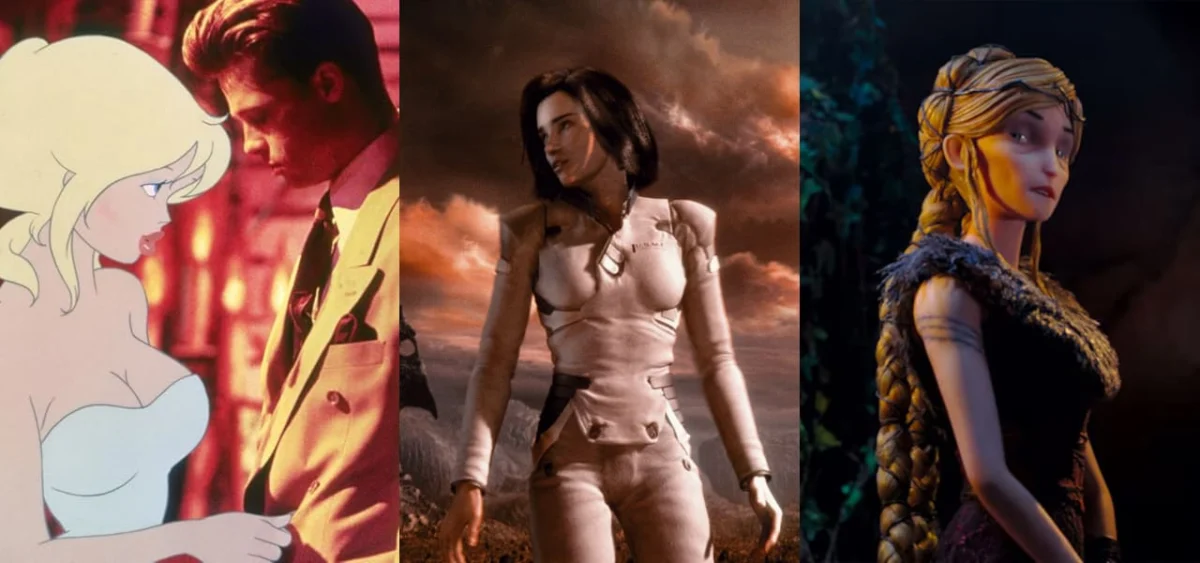
Setting aside retrospective classifications, the true trailblazers of the PG-13 rating were hybrid projects. Ralph Bakshi’s Cool World (1992) stands as the first officially rated PG-13 hybrid feature. Conceived as an R-rated, subversive spin on Roger Rabbit, producer Frank Mancuso Jr. ordered script rewrites to target a PG-13 demographic without informing Bakshi.
Resentful of the studio meddling, Bakshi told his animators to ignore the script entirely and draw whatever they pleased. Storyboard artist Conrad Vernon later recalled, "It’s the only guerrilla animated film. We never knew what we were drawing, because no one ever read a script." The resulting mess was chaotic, featuring Milton Knight’s retro animation and Barry E. Jackson’s nightmarish backgrounds, but it cemented a new rating bracket.
Later that same year, Bebe’s Kids (1992) claimed the title of the first fully animated feature released with a PG-13 rating. Directed by Bruce W. Smith—creator of The Proud Family—and based on a stand-up routine by Robin Harris, the film delivered snappy, expressive animation alongside adult humor that avoided cheap shock value.
The Blockbusters and Studio Retrenchments
As the 1990s drew to a close, MTV’s cultural phenomenon Beavis and Butt-Head Do America (1996) proved that adult-leaning animation could dominate the box office. Creator Mike Judge successfully fended off studio pressures to turn the property into a live-action vehicle starring Adam Sandler and David Spade. While a scene involving whiskey had to be excised, Judge retained a psychedelic peyote-induced hallucination sequence directed by Chris Prynoski.
The early 2000s saw a brief, coordinated push by major studios to capture the teen and pre-teen demographic with action-oriented cartoons like Titan A.E. (2000), Atlantis: The Lost Empire (2001), Treasure Planet (2002), and Sinbad: Legend of the Seven Seas (2003). However, underperforming box-office returns caused Hollywood to quickly retreat back to safe, four-quadrant family fare.
Creative friction frequently marred these attempts. Speaking about DreamWorks’ The Road to El Dorado (2000), producer Bonnie Radford noted: "We originally thought it would be rated PG-13, so we skewed it to that group, but then we thought we could not exclude the younger kids, so we had to tone the romance down." Pencil tests from animators Rodolphe Guenoden and James Baxter reveal a far steamier edge that was scrubbed from the final cut.
Similarly, Warner Bros. panicked over the initial PG-13 cut of the biological comedy-hybrid Osmosis Jones (2001), which earned its restrictive rating for "crude language and bodily humor." Studio executives cut the film down to a PG, scrubbing a sequence set within the protagonist’s testicles. Another 2001 hybrid, Henry Selick’s Monkeybone, suffered catastrophic executive interference when Twentieth Century Fox leadership attempted to neuter its surrealism into a mainstream comedy, creating one of the strangest studio misfires in cinematic history.
Supporting Data and Industry Case Studies
While American studios struggled to monetize mature animation, high-profile exceptions occasionally broke through:
- The Simpsons Movie (2007): Directed by David Silverman, this massive box-office hit bypassed traditional content warnings, receiving an MPA rating simply for "irreverent humor throughout."
- 9 (2009): Produced by Tim Burton and directed by Shane Acker, this post-apocalyptic sci-fi fable offered a glimpse into a darker visual style for CG animation, though it failed to spark a broader trend.
- Isle of Dogs (2018): Wes Anderson’s stop-motion feature leaned into thematic elements and violent imagery, embracing a PG-13 classification that matched his offbeat live-action aesthetic.
- Wendell & Wild (2022): Henry Selick’s Netflix-backed stop-motion feature earned a PG-13 label largely due to "substance use," immortalized by a scene where two demons hallucinate after ingesting hair cream.
The International Alternative: Anime and the Global Market
While domestic studios remained terrified of alienating families, Japan proved that mature animation could achieve monumental financial and cultural success. Hayao Miyazaki’s epic fantasy Princess Mononoke (1997) received a PG-13 rating in the United States and briefly reigned as Japan’s highest-grossing film. Famously, when Miramax chief Harvey Weinstein suggested editing the film for American audiences, Studio Ghibli producer Toshio Suzuki sent him a samurai sword with a blunt message: "No cuts."
In the decades since, international features like The Triplets of Belleville, Persepolis, Flee, and Robot Dreams have claimed Academy Award recognition. In 2023, Miyazaki’s The Boy and the Heron shattered barriers by becoming the first PG-13 animated feature to win the Oscar for Best Animated Feature.
Implications: The Damaging Myth That "Animation is for Kids"
The systemic scarcity of American PG-13 animated features is not merely a bureaucratic trivia point—it inflicts tangible damage on the cinematic ecosystem.
In the United States, the pervasive cultural bias that "animation is strictly for kids" forces a false binary upon viewers. Adolescents and young adults who have outgrown simplistic moral fables, but are not yet seeking the explicit raunchiness of films like Fritz the Cat, find themselves ignored by domestic studios. When Hollywood refuses to provide animated content that addresses action, sensuality, and complex themes, young audiences gravitate toward live-action fare, internalizing the false belief that cartoons are a medium to be outgrown.
This vacuum explains the explosive popularity of anime among American teenagers. Creators like Hiroyuki Imaishi (Promare, 2019) demonstrate that kinetic, hyper-stylized action combined with mature storytelling can capture a massive demographic that Western studios routinely abandon.
Official Responses and Industry Outlook
As the industry looks toward the release of Laika’s Wildwood, veteran creators and studio executives are once again debating the commercial viability of a middle-ground rating.
Animation historians argue that expanding the boundaries of the medium does not require photorealistic approximations of live-action—a trap that doomed early-2000s experiments like Final Fantasy: The Spirits Within (2001) and Robert Zemeckis’s motion-capture features like Beowulf (2007). As legendary animator Chuck Jones famously observed: "Animation is an extension of motion pictures, not an imitation."
Whether Wildwood heralds a new dawn for mainstream American PG-13 animation or remains an isolated artistic outlier remains to be seen. What is clear, however, is that an entire generation of viewers is hungry for stories that honor the stylistic elasticity of animation while speaking to a more mature worldview.
