
The Shapeshifter of the Seas: Uncovering Leonard Nimoy’s Eight-Role Legacy on Sea Hunt

Before he was the stoic, logic-driven Vulcan Science Officer Spock on Star Trek, Leonard Nimoy was a ubiquitous face in the living rooms of mid-century America. While history remembers him for his iconic pointed ears and green-blooded persona, his climb to television stardom was paved by a relentless work ethic and an extraordinary versatility that allowed him to vanish into the fabric of the era’s most popular programs. Perhaps nowhere is this more evident than in the syndicated adventure hit Sea Hunt, where Nimoy appeared in eight different roles between 1958 and 1961—a record of guest appearances that stands as a testament to his early career as a quintessential character actor.
The Context: A Golden Era of Television Adventure
The late 1950s and early 1960s represented a tectonic shift in the American television landscape. While the Western genre dominated the airwaves with shows like Gunsmoke and Rawhide, a distinct appetite for high-stakes adventure and aquatic mystery emerged.
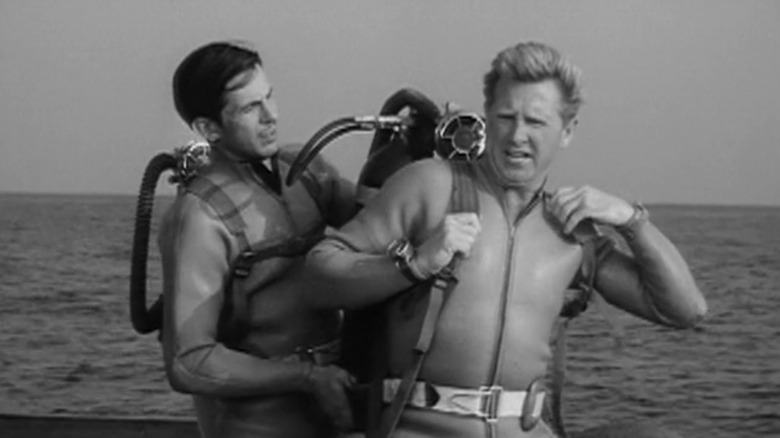
At the center of this trend was Sea Hunt, a series that followed Mike Nelson, a former Navy frogman turned freelance diver portrayed by Lloyd Bridges. The show was a masterclass in low-budget, high-concept television, utilizing the then-nascent technology of SCUBA gear to create tense, underwater set pieces that were unlike anything else on the small screen. For Bridges, the show was a lifeline. Having been blacklisted during the McCarthy-era investigations of the House Un-American Activities Committee (HUAC), Bridges’ career had stalled. Sea Hunt provided a necessary escape from the political smog of Los Angeles, allowing him to reclaim his status as a leading man. Running for 155 episodes, the show became a syndication juggernaut, providing a reliable platform for hungry young actors to cut their teeth alongside a seasoned professional.
The Versatility of a Future Icon
Leonard Nimoy’s presence on Sea Hunt was not merely a footnote; it was a career-defining period of experimentation. Between his first appearance in 1958 and his final cameo in 1960, Nimoy cycled through a range of personas that demonstrated a startling acting range. From victims of circumstance to cold-blooded antagonists, Nimoy’s ability to morph into different characters made him a favorite for casting directors.
Unlike some actors who were pigeonholed early on, Nimoy approached each Sea Hunt role with the seriousness of a lead. This period of "chameleon acting" provided him with the necessary experience to later anchor the complex emotional landscape of Spock. By the time he reached the bridge of the USS Enterprise in 1966, he had already played everything from a desperate storm survivor to a calculated villain, providing him with a deep reservoir of performance techniques.

A Chronology of Appearances: The Evolution of a Guest Star
The Initial Survivalist: "The Shipwreck" (1958)
Nimoy’s debut on Sea Hunt occurred in the 30th episode of the first season, titled "The Shipwreck." Here, he played Vince, a character caught in a classic mid-century television dilemma: a capsized boat, an open ocean, and the race against time. Working alongside Nancy Hale, Nimoy helped ground the episode in a realistic, harrowing struggle for survival. It was a grounded performance that established his reliability as a supporting player who could handle high-tension scenes with grace.
The Antagonist: "Dead Man’s Cove" (1958)
Only three episodes later, the audience saw a completely different side of Nimoy. As Robert Tyler in "Dead Man’s Cove," he played a man embroiled in a suspicious drowning investigation. The episode reached its crescendo in a literal and metaphorical showdown between Tyler and Nelson. The climactic underwater fight scene, where the victor was determined by lung capacity and endurance, showcased a darker, more predatory intensity that hinted at the complexity Nimoy would later bring to more nuanced roles.
The Uncredited and the Unhinged (Season 2)
As the show entered its second season, Nimoy’s participation grew more frequent and more eclectic. He appeared in two uncredited roles—a student and an explosives thief—illustrating the "working actor" ethos of the time, where performers would take any available slot to pay the bills and build their resumes.
In the Season 2 premiere, he took on the role of a deceitful brother, a performance defined by hidden motives and shifting loyalties. Later, in the episode "Nerve Gas," he portrayed an amateur diver whose psychological breakdown after encountering a submerged Japanese submarine allowed Nimoy to lean into erratic, high-energy acting, contrasting sharply with his earlier, more stoic portrayals.
The Final Mission: "The Invader" (1960)
Nimoy’s final appearance in the series came in the Season 3 episode "The Invader." Playing Indio Ramirez, a trainee frogman on a dangerous mission to rescue a foreign head of state, Nimoy finally got to play a role that involved a collaborative partnership with Lloyd Bridges. The episode served as a satisfying capstone to his tenure on the show, moving from the antagonist of the first season to a reliable ally in the third.

Supporting Data: The Broader Landscape of Nimoy’s Early Career
To understand the significance of the Sea Hunt years, one must look at the volume of work Nimoy was producing concurrently. His tenure on Sea Hunt occurred while he was also appearing in multiple episodes of Broken Arrow, Wagon Train, and Gunsmoke.
The sheer frequency of these appearances suggests an actor in the prime of his developmental phase. According to industry records from the era, Nimoy was one of the most booked guest actors in Hollywood. This density of work was not merely about quantity; it was about the diversity of archetypes. In Rawhide, he played characters vastly different from the frogmen he portrayed in Sea Hunt. This constant rotation of roles prevented him from becoming a "type," allowing him to refine his ability to communicate character through minimal dialogue and precise physicality—a skill that would later define his performance in Star Trek.
Implications for Modern Television Studies
The case of Leonard Nimoy on Sea Hunt offers a valuable case study for modern television scholars. It highlights the "repertory company" nature of early television, where producers frequently relied on a stable of familiar, reliable faces to fill out their casts.
For the viewer, seeing Nimoy in these roles offers a unique "archaeology of stardom." It forces us to confront the fact that our greatest icons often spent years in the shadows of popular, but ultimately transient, series. It also challenges the narrative that an actor’s success is a singular climb; rather, it is often a series of disparate, seemingly unconnected roles that build the foundation for a career-defining character.
Furthermore, the transition of Lloyd Bridges from a blacklisted pariah to a television hero through Sea Hunt mirrors the industry’s own evolution. The show served as a sanctuary for those marginalized by the political climate of the 1950s, creating a space where talent was prioritized over ideology. Nimoy’s participation in this sanctuary is a testament to the importance of these "forgotten" shows in maintaining the livelihood of a generation of actors.
Conclusion: The Legacy of the Guest Star
Leonard Nimoy’s eight appearances on Sea Hunt are more than just trivia for Star Trek completionists. They represent the grueling, necessary apprenticeship of a master craftsman. While the episodes themselves may have faded from the cultural consciousness, the lessons Nimoy learned while navigating the fictional waters of Mike Nelson’s world remained with him for the rest of his life.
From the desperate survivor to the tactical trainee, each of these eight characters allowed Nimoy to practice the art of being "someone else." By the time he donned the uniform of the United Federation of Planets, the lessons learned in the salt spray of Sea Hunt had been fully integrated. Nimoy’s career reminds us that the path to iconic status is rarely a straight line, but rather a winding, adventurous journey through the episodic landscapes of a bygone era. In the end, the man who would play a Vulcan of pure logic was, in his early years, a man of infinite, shifting identities.
