
Finding Peace in the Crossfire: Reed Van Dyk’s ‘Atonement’ Examines the Long Shadows of the Iraq War
By Global Cinema Desk
Published as part of our extended 2026 TIFF coverage. The film opens in theaters nationwide on October 2 via Kino Lorber.
Main Facts
The human toll of modern warfare rarely ends with the signing of a peace treaty or the official withdrawal of troops. Instead, it reverberates through decades, echoing silently in the daily lives of survivors and perpetrators alike. This enduring trauma is the focal point of Atonement, the ambitious feature-length directorial debut by Reed Van Dyk. Following a critically acclaimed run on the festival circuit—including a prominent premiere at the 2026 Toronto International Film Festival (TIFF)—the film is set to receive a theatrical release on October 2.
Based on Dexter Filkins’ acclaimed 2012 New Yorker article, "Atonement After Iraq," the film chronicles a tragic, real-life friendly-fire incident from the 2003 US invasion of Baghdad and its harrowing aftermath. In the film (which changes the real Kachadoorian family’s name to the Khatchaturians), a civilian family driving to their home is tragically mistaken for insurgents by American soldiers. The ensuing gunfire kills the family patriarch and two sons, leaving the mother and daughter physically and emotionally scarred.
Years later, one of the traumatized soldiers, consumed by crushing guilt, seeks out the journalist who covered the story to orchestrate a nearly impossible reunion with the surviving family members living in the United States. Starring an ensemble cast that includes Boyd Holbrook, Hiam Abbass, Kenneth Branagh, and young actress Gheed, Atonement attempts to balance the macro-political tragedies of the Iraq War with the micro-level, intimate agony of individual accountability, reconciliation, and survival.
Chronology: From a Baghdad Intersection to California Courts
To fully understand the cinematic structure of Atonement, one must trace the timeline of both the real-life historical events and the three-tiered narrative crafted by Van Dyk.
Phase 1: The Baghdad Intersection (2003)
The film opens with a profound perspective shift, anchoring its first act in a naturalistic domestic drama set in Baghdad during the initial 2003 American invasion. Eschewing the typical Hollywood tropes that render Middle Eastern communities as mere tactical obstacles or faceless zones of conflict, Van Dyk presents the Khatchaturian family going about their everyday routines—bickering, watching television, and living within a vibrant neighborhood.
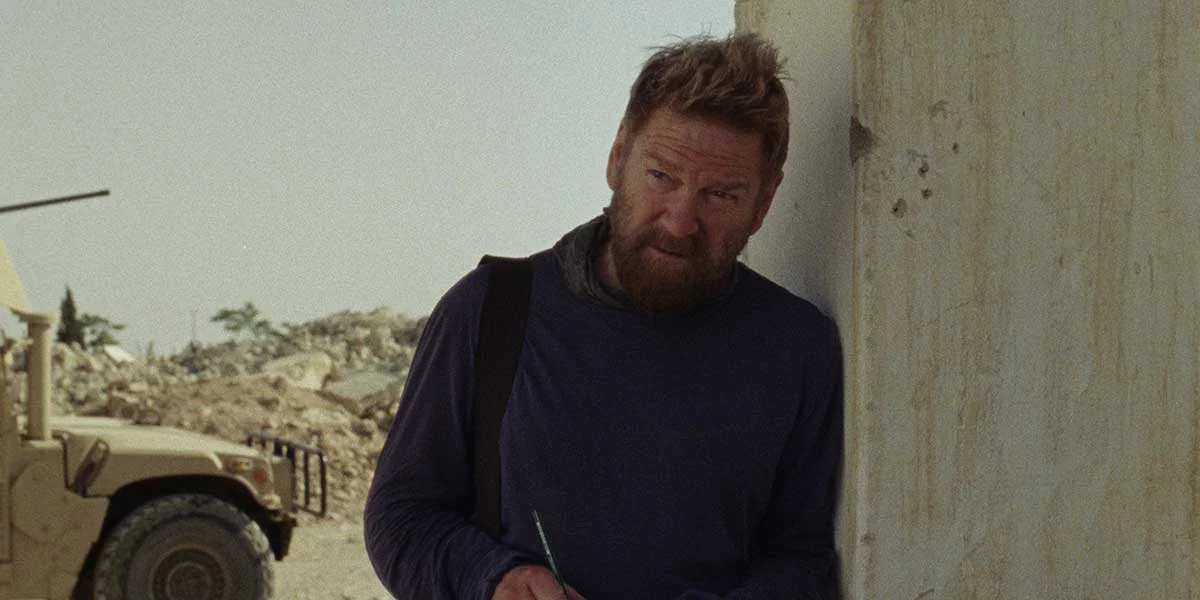
This fragile normalcy is violently shattered when a nearby explosion rocks the area. Desperate to return home, the family drives through a local intersection. Simultaneously, a platoon of American soldiers, operating under extreme combat paranoia and heightened alertness, misinterprets the approaching vehicle. Private Lou (played by Boyd Holbrook) opens fire. In seconds, the husband and two sons of Mariam (Hiam Abbass) are killed, and her daughter Nora (Gheed) is severely injured. Investigative journalist Michael (Kenneth Branagh) arrives shortly after to document the immediate aftermath.
Phase 2: A Decade of Dissolution (Mid-2010s)
Atonement then executes a dramatic time-jump of more than a decade, dividing its narrative into three distinct chapters. The first focuses squarely on Lou, now a law student living in San Diego. Discharged dishonorably, Lou battles severe Post-Traumatic Stress Disorder (PTSD) and crippling substance abuse. His internal spiral intensifies exponentially when a former platoon member shares Michael’s old journalistic account of the Baghdad shooting before tragically committing suicide. Driven by a desperate need for absolution, Lou contacts the journalist, setting the stage for a perilous attempt to locate the surviving family members.
Phase 3: The Collision of Two Worlds (Present Day)
The final chapter shifts its focus to Mariam, who has relocated to California alongside her surviving daughter, Nora. Van Dyk’s deliberately fractured narrative attempts to piece these fractured lives back together once Lou, Michael, and the Khatchaturians eventually find themselves in the same room. However, the journey there is paved with narrative gaps, emotional hesitation, and profound structural hurdles.
Supporting Data and Context
To evaluate the weight of Atonement, one must look at the journalistic bedrock provided by Dexter Filkins’ original reporting in The New Yorker and his earlier coverage for The New York Times. Filkins specialized in reporting from the front lines of conflict zones, developing a reputation for capturing the invisible, long-term psychological fallout experienced by both occupied civilian populations and combat veterans.
- The Real-Life Counterparts: In reality, the Kachadoorian family’s ordeal became a touchstone for discussions regarding the rules of engagement, urban warfare, and the chaotic nature of counterinsurgency operations during the early years of the Iraq War.
- The Veteran Suicide Crisis: Lou’s storyline touches upon statistical realities heavily documented by the U.S. Department of Veterans Affairs. Rates of PTSD, major depressive disorders, and substance abuse among post-9/11 combat veterans remain critically high, with moral injury—the deep psychological pain resulting from actions that violate one’s moral code, such as friendly fire incidents—acting as a primary driver for veteran self-harm.
- Cinematographic Choices: Working alongside cinematographer Jon Peters, Van Dyk utilizes stark visual contrasts. The chaotic, hand-held, high-tension camera work of the 2003 Baghdad firefight intentionally mimics the claustrophobic panic of the soldiers. In stark contrast, the later scenes set in sun-bleached California feature a muted, restrained visual palette, symbolizing emotional numbness and the lingering, quiet weight of unhealed wounds.
Official Responses and Critical Reception
Since its debut at the Toronto International Film Festival, Atonement has sparked intense debate among film critics, military veterans, and human rights advocates regarding its handling of such a delicate, explosive premise.
Praise for Sincerity and Craftsmanship
Critics have universally lauded Reed Van Dyk for his artistic ambition. Building upon the success of his Oscar-nominated short film DeKalb Elementary, Van Dyk demonstrates a rare maturity in handling sensitive subject matter without resorting to exploitative sensationalism.
- Performances: Hiam Abbass delivers a masterclass in quiet dignity and suppressed grief, anchoring the emotional core of the film’s final act. Boyd Holbrook captures the jittery, hollowed-out desperation of a man haunted by his own actions, while Kenneth Branagh provides a stabilizing, observant presence as the journalist caught between two irreconcilable worlds.
- A Fresh Lens: Reviewers have praised the film’s opening Baghdad sequences for offering a rare, humanizing portrayal of Iraqi civilian life before the invasion—a cinematic choice deemed "revelatory" in the context of mainstream American war narratives.
Critiques of Narrative Restraint
Despite widespread respect for its sincerity, many critics have pointed out structural shortcomings. Because the film relies heavily on a restrained, atmospheric direction, it often shies away from answering the thorny ethical questions it raises.
- The "Shoot-and-Cry" Trope: Some cultural analysts have noted that centering the narrative heavily around Lou’s redemption arc risks falling into the well-worn cinematic trap of prioritizing the emotional recovery of the American perpetrator over the generational trauma experienced by the Iraqi victims—especially since Mariam’s point-of-view is deliberately withheld until the final moments for dramatic effect.
- A Prompt for Discussion, Not a Resolution: Ultimately, critics argue that the constraints of a standard feature-length runtime prevent the film from fully grappling with the sheer messiness of forgiveness. Rather than offering concrete emotional closure, Atonement functions primarily as a sophisticated philosophical prompt.
Implications: The Cinematic Legacy of Modern War
As Atonement prepares for its wide theatrical release via Kino Lorber on October 2, its cultural and cinematic implications extend far beyond the box office.
- Re-evaluating the War Film Genre: For decades, American cinema has tackled the Iraq and Afghanistan wars primarily through the lens of tactical heroism, political satire, or straightforward trauma memoirs focused solely on U.S. soldiers. Atonement represents a growing subgenre of contemporary filmmaking that attempts to bridge the vast chasm between occupier and occupied, recognizing that both are ultimately victims of larger, unyielding geopolitical machinations.
- The Limits of Cinematic Reconciliation: The film raises uncomfortable questions about whether true reconciliation is possible in the shadow of imperial violence. Can an apology—no matter how sincere, guilt-ridden, or desperately sought—bridge the gap left by lost lives and shattered families? By refusing to offer a neat, Hollywood-style resolution, Van Dyk suggests that some wounds inflicted by war are fundamentally irreconcilable.
- A Promising Director to Watch: Despite its narrative imbalances, Atonement firmly establishes Reed Van Dyk as a filmmaker of uncommon sensitivity and intellectual curiosity. By tackling a subject where easy answers do not exist, Van Dyk has crafted a film that may leave audiences frustrated by its lack of resolution, yet deeply moved by its unwavering commitment to the complexities of human suffering.
Atonement opens in select theaters nationwide on October 2.
