
The Future of On-Set Connectivity: Deep Dive into the Hollyland Pyro 7 Ultra
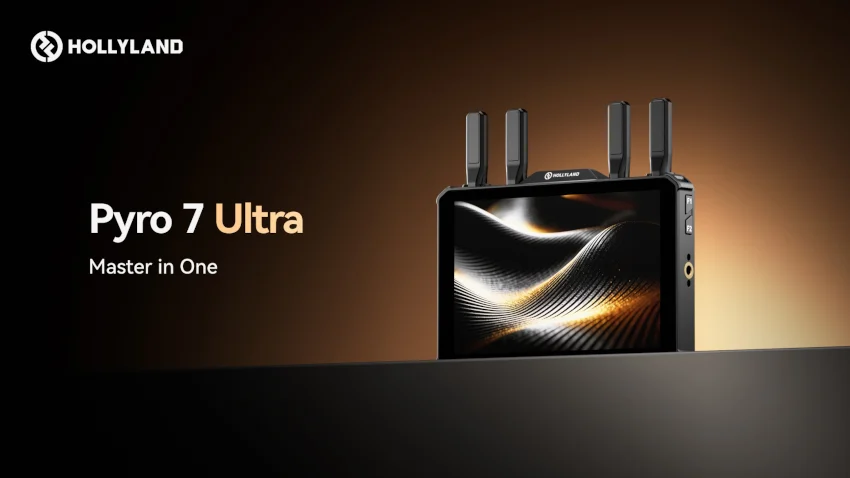
In the fast-evolving landscape of professional cinematography, the ability to maintain a seamless, high-fidelity visual link between the camera and the rest of the crew is the difference between a smooth production and a logistical nightmare. Traditionally, this requirement necessitated a cluttered ecosystem of external wireless transmitters, bulky receivers, and standalone monitors. Hollyland, a brand synonymous with wireless innovation, is looking to dismantle this complexity with its latest offering: the Pyro 7 Ultra.
This 7.02-inch, all-in-one wireless transceiver monitor represents a significant shift in production workflows. By integrating high-end display technology with robust, proprietary wireless transmission hardware, the Pyro 7 Ultra seeks to provide directors, focus pullers, and DITs with a single, portable solution that eliminates the friction of traditional multi-component rigs.
Main Facts: A Convergence of Display and Transmission
The Hollyland Pyro 7 Ultra is not merely a monitor; it is a hybrid device designed to serve as the nerve center for on-set monitoring. At its core, the unit is a 7.02-inch QD-LCD touchscreen that offers a crisp 1920 x 1200 resolution. However, the hardware specifications go well beyond simple pixel density.
Engineered for critical monitoring, the display features a peak brightness of 1,500 nits, ensuring that even in the harsh glare of direct sunlight, the image remains visible and punchy. Perhaps most impressive for color-critical work is the factory-level calibration; each unit is Calman-verified to achieve a Delta E of less than 1.5. Supporting 99% of the Rec.709 color gamut and 95% of DCI-P3, the Pyro 7 Ultra provides the reliability needed for professional color grading and exposure assessment.
The integrated wireless capabilities are powered by Hollyland’s "TWiFi" (Twin-WiFi) technology. This system utilizes a dual-band approach (2.4 GHz and 5 GHz) with advanced frequency-hopping algorithms, allowing the device to maintain a stable signal in RF-congested environments. With a rated range of up to 1 km (3,300 feet) and support for 4K60 video transmission, the device is built to handle the most demanding broadcast and narrative requirements.
Chronology: The Evolution Toward Integration
To understand the significance of the Pyro 7 Ultra, one must look at the trajectory of on-set monitoring over the last decade. Historically, wireless video was a luxury reserved for high-budget feature films. Early systems were bulky, unreliable, and often suffered from significant latency, forcing focus pullers to rely on wired connections.
As the industry moved toward 4K and HDR, the demand for wireless systems that could support higher bandwidth increased. Companies like Hollyland began by releasing standalone transmitters and receivers, which were then paired with third-party monitors. This "modular" approach was flexible but inherently prone to failure points—cables would snag, batteries would run out on multiple devices, and the physical weight of mounting a transmitter onto a monitor made it cumbersome for hand-held camera operators.
The introduction of the Pyro series by Hollyland signaled the next logical step: the integration of transmission and display. The Pyro 7 Ultra serves as the culmination of this trend. It arrives at a time when the lines between traditional broadcast and digital cinema are blurring, and productions are increasingly looking for "all-in-one" tools that reduce setup time and equipment footprint without compromising quality.

Supporting Data: Technical Performance and Reliability
The Pyro 7 Ultra’s technical prowess is defined by its ability to balance high-resolution video with low-latency transmission. In the professional world, "latency is the enemy." Hollyland has addressed this through a dedicated "Focus Mode." Under controlled testing, the device achieves a latency of just 20 ms at 1080p25/30, 40 ms at 1080p60, and 45 ms at 4K60. This is a critical threshold, as it allows focus pullers to track movement in real-time, effectively eliminating the "delay-induced blur" that often plagues lower-end wireless systems.
Connectivity and Control
The connectivity suite is designed for versatility. Featuring both HDMI and SDI, the monitor supports loop-through and cross-output, ensuring it can fit into virtually any camera chain—whether it’s a mirrorless setup or a high-end cinema camera like those from ARRI, Canon, or Sony.
Furthermore, the integration of camera control is a game-changer. Users can adjust key settings—shutter speed, aperture, ISO, and white balance—directly from the touchscreen. This reduces the physical movement required by the crew, allowing a director or DIT to make adjustments without needing to interrupt the camera operator.
Power and Ergonomics
Weight and power management are the silent killers of on-set morale. The Pyro 7 Ultra weighs in at a mere 630 grams. By incorporating a V-mount battery plate and dedicated DC input, Hollyland has ensured that the device can survive a full day of shooting on a standard power brick, eliminating the "cable spaghetti" often associated with external battery solutions.
Official Perspectives: The HollyOS Advantage
The hardware is only as good as the software driving it. Hollyland has equipped the Pyro 7 Ultra with HollyOS, an operating system tailored for the high-pressure environment of a film set. The UI is designed to be intuitive and rapid, minimizing the number of menu taps required to access critical tools like waveform, histogram, false color, and anamorphic de-squeezing.
Hollyland notes that the OS is designed to be a "production-focused layer." By offering customizable monitoring layouts, the system allows the DIT to configure the screen exactly how the specific department needs it. The inclusion of LUT support and safety frames further cements the device as a professional tool rather than a consumer-grade accessory.
The ability to recalibrate the display in the field using Hollyland’s own software, without needing a PC or external sensor, is a major nod to the needs of location-based crews. This self-sufficiency ensures that as the QD-LCD panel ages, the color accuracy remains consistent throughout the life of the product.
Implications for the Industry
The release of the Pyro 7 Ultra signals a shift in the hierarchy of on-set equipment. By consolidating these functions, Hollyland is effectively lowering the barrier to entry for high-quality wireless monitoring.

Reducing Equipment Complexity
For the independent producer or the small-to-medium-sized production house, the Pyro 7 Ultra offers a massive simplification of the kit list. Instead of buying a high-end monitor and a high-end wireless system separately—potentially spending thousands more—the production can invest in an integrated ecosystem. The "Broadcast Mode," which allows a single transmitter to push a signal to an unlimited number of receivers, means that one transmitter can feed the director, the client, the focus puller, and the DIT simultaneously, provided they are all using compatible Pyro hardware.
Enhancing Collaboration
The most profound implication is the impact on collaboration. When the director, the cinematographer, and the focus puller are all viewing a high-fidelity, color-accurate image with near-zero latency, the feedback loop between them becomes tighter. The "creative friction" that occurs when a director sees a lower-resolution or delayed feed compared to what the camera is actually capturing is minimized.
A New Standard for Workflow?
As the industry continues to prioritize mobility and speed, the Pyro 7 Ultra sets a benchmark for what a monitoring device should be. It is no longer enough to simply "show the image." Today’s monitors must transmit, control, and calibrate.
For the professional, the $1,399 price point represents a significant value proposition. It bridges the gap between the entry-level consumer market and the high-end, five-figure rental house solutions. While no single piece of hardware can solve every production challenge, the Pyro 7 Ultra makes a compelling case for the integrated, all-in-one future.
Conclusion
The Hollyland Pyro 7 Ultra is a testament to the fact that hardware innovation is still alive and well in the cinema industry. By focusing on the "pain points" of the crew—cables, latency, color shift, and menu complexity—Hollyland has delivered a device that is as much about productivity as it is about image quality.
Whether it is being used on a run-and-gun commercial shoot or a multi-camera narrative production, the Pyro 7 Ultra offers a level of connectivity that was previously only accessible to those with deep pockets and large support teams. As it becomes a fixture on more sets, it will likely be viewed as a turning point where the "integrated monitor" replaced the "modular rig," providing a cleaner, faster, and more reliable way to capture the magic of cinema.
