
The Real-Time Pressure Cooker: Walker & Harley Films and Fathom Studios Announce Glen Merzer’s Explosive Character Drama Buddhist Blues
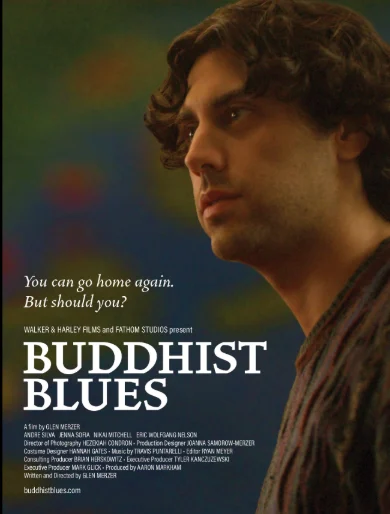
LOS ANGELES — In a cinematic landscape increasingly dominated by digital spectacle, CGI heavyweights, and rapid-fire editing suites, a daring new independent feature is swimming hard against the current. Walker & Harley Films, in partnership with Fathom Studios, has officially announced the upcoming release of Buddhist Blues, a gripping, uncompromising new feature film written and directed by filmmaker and playwright Glen Merzer.
Crafted with theatrical precision and cinematic intimacy, Buddhist Blues is designed to unfold in absolute, unbroken real time. The film traps its audience directly in the room as four distinct lives violently unravel in less than ninety minutes, delivering the raw, uninterrupted tension of an award-winning Broadway play brilliantly captured on the silver screen.
As distribution details and festival premiere dates loom on the horizon for the coming weeks, industry insiders are already taking note of the film’s high-wire stylistic choice, which promises to deliver a visceral, edge-of-the-seat experience reminiscent of the greatest claustrophobic dramas in cinematic history.
Main Facts: The Anatomy of Buddhist Blues
At its core, Buddhist Blues is an intimate, explosive character study that relies on the terrifying momentum of continuous time. Set against the atmospheric backdrop of 1993 St. Louis, Missouri, the film follows a tight-knit quartet of individuals whose lives collide in a residential living room under the weight of cultural friction, familial estrangement, and long-buried secrets.
The narrative ensemble is anchored by a talented cast:
- Lou (played by Eric Wolfgang Nelson): A complicated man living firmly outside the boundaries of the law, deeply estranged from his traditional Jewish family. Driven by a desperate, perhaps reckless bid for connection, he orchestrates a high-stakes family visit.
- Susan (played by Jenna Sofia): Lou’s cousin and a practicing psychiatrist who is desperately attempting to steady her own life in the wake of a fresh, painful divorce.
- Nick (played by Andre Silva): Susan’s newly minted ex-husband, whose presence in the space introduces immediate tension, residual emotional baggage, and lingering questions about the dissolution of their marriage.
- Lili (played by Nikai Mitchell): Lou’s Black girlfriend, who unwittingly ignites the narrative fuse by arriving at Susan’s home ahead of Lou.
From the moment Lili steps across the threshold, a literal and metaphorical countdown begins. Over the course of a harrowing 90-minute window, decades of family trauma, racial dynamics, and personal betrayals collide, ensuring that none of the four characters will ever be the same by the time the closing credits roll.
Behind the camera, writer-director Glen Merzer has assembled a top-tier creative and technical team to bring his vision to life. The film features meticulous, period-accurate production design by Joanna Samorow-Merzer and evocative, tightly controlled cinematography by Hezekiah Condron, both of whom work in tandem to capture the suffocating intimacy of the St. Louis setting. The crew is rounded out by costume designer Hannah Gates, editor Ryan Meyer, and an atmospheric original score composed by Travis Puntarelli.
On the executive and production side, Buddhist Blues is produced by Aaron Markham, with Brian Herskowitz lending his expertise as consulting producer. Tyler Kanczuzewski and Mark Glick serve as executive producers, backing a project designed specifically to challenge conventional cinematic grammar.
Chronology and Narrative Mechanics: The Art of Unbroken Time
To truly understand the ambition of Buddhist Blues, one must examine the rare and formidable narrative device it employs: real-time storytelling. While television has famously utilized the high-wire act of real-time pacing to fuel explosive action thrillers like 24, and cinema has occasionally toyed with the concept in timeless classics such as Alfred Hitchcock’s Rope, Richard Linklater’s Before Sunset, and Sidney Lumet’s 12 Angry Men, Merzer applies this intense pressure-cooker mechanism to an intimate, interpersonal character drama.
By stripping away cinematic ellipsis—the traditional time-jumps, dissolves, and montage sequences that allow audiences to catch their breath—Buddhist Blues forces viewers to experience every single breath, hesitation, and verbal confrontation alongside the characters in agonizing sync.
The chronology of the film mirrors the exact span of its runtime:
- Minute Zero: Lili arrives at Susan’s St. Louis home ahead of Lou. The environment is immediately charged; Susan is navigating the awkward aftermath of her divorce from Nick, and the arrival of an unexpected guest breaks whatever fragile peace the household was maintaining.
- The Escalation Phase: As the minutes tick away in real time, Lou finally arrives. What was initially intended to be a simple, albeit strained, family reconnection rapidly spirals outward. The presence of Lou—an outlaw operating on the fringes of society—brings long-standing grievances with his Jewish family to the surface.
- The Climax: Cultural friction and historical wounds intersect with deeply personal romantic betrayals involving Susan, Nick, and Lili. Because the narrative cannot jump forward to a peaceful resolution or offer a commercial break to diffuse the tension, the characters are forced to address their grievances in real time, leading to explosive confrontations that test the limits of their relationships.
- The Resolution: As the 90-minute mark approaches, the cumulative weight of the afternoon’s revelations alters all four lives irreversibly.
This strict adherence to real time means that the actors had to perform sprawling, multi-page sequences with the precision and stamina of theatrical performers. There is no hiding behind clever editing cuts or framing tricks; the camera remains an unblinking witness to the emotional wreckage.
Supporting Data: Contextualizing Real-Time Cinema
Real-time filmmaking is widely regarded by industry veterans as one of the most demanding disciplines in the audiovisual arts. Historically, filmmakers who have attempted to simulate or strictly adhere to continuous time have done so to achieve very specific psychological effects—primarily claustrophobia, urgency, and radical transparency between the audience and the subject.
| Film / Series | Release Year | Primary Genre | Approach to Real Time |
|---|---|---|---|
| Rope | 1948 | Psychological Thriller | Simulated continuous take across roughly 80 minutes in a single apartment setting. |
| 12 Angry Men | 1957 | Legal Drama | Follows a jury deliberation progressing almost entirely in real time over roughly 96 minutes. |
| Before Sunset | 2004 | Romantic Drama | A conversation between two former lovers unfolds in real time over an 80-minute afternoon walk in Paris. |
| 24 (Series) | 2001–2010 | Action / Thriller | Each 24-episode season covers a single day, with each episode representing one hour in real time. |
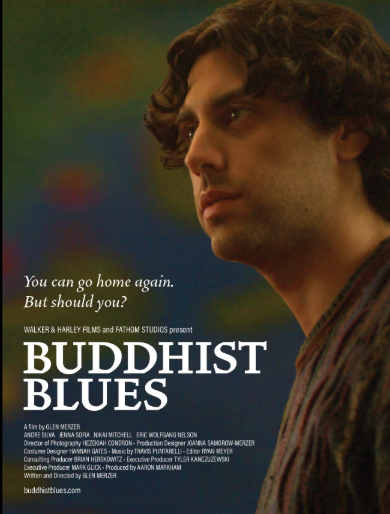
| Buddhist Blues | 2026 | Character Drama | Unfolds in absolute real time over 90 minutes within a single residential location. |
As demonstrated by this lineage, real-time storytelling shifts the burden of performance almost entirely onto the actors and the strength of the dialogue. Without the safety net of editorial manipulation, pacing must be achieved organically through emotional escalation, shifting power dynamics, and rhythmic dialogue delivery. Buddhist Blues positions itself as a modern torchbearer for this tradition, updating the concept for a contemporary audience hungry for raw, dialogue-driven performances.
Official Responses and Creative Vision
The creative forces behind Buddhist Blues have been vocal about the unique philosophy that guided the production from its inception on the page to its realization on screen.
"Real-time storytelling leaves nowhere for the characters—or the audience—to hide," explains writer-director Glen Merzer. "Like great theater, the stakes organically escalate because you cannot cut away from the discomfort or the truth. It demands absolute precision from the actors and the filmmaking team. You are asking an audience to sit in a room with these people as their lives shatter, and that requires an immense amount of trust between the performers and the viewers."
The collaborative ethos of the production was heavily supported by independent powerhouses Walker & Harley Films and Fathom Studios. Both production companies have built their reputations on championing character-driven, provocative storytelling that routinely challenges traditional cinematic structures. In an era where independent cinema often chases commercial trends or high-concept sci-fi hooks, the decision by Walker & Harley and Fathom to back a deeply intimate, dialogue-heavy 90-minute chamber piece underscores a commitment to bold, risk-taking artistry.
Executive producers Tyler Kanczuzewski and Mark Glick, alongside producer Aaron Markham, recognized early on that Buddhist Blues possessed the rare qualities required to transcend standard indie fare. By focusing on intersectional cultural dynamics, familial estrangement, and personal accountability within a ticking-clock framework, the film aims to spark vital conversations long after the screen goes dark.
Implications for Independent Cinema and Distribution
The announcement of Buddhist Blues arrives at a fascinating crossroads for the entertainment industry. As major studios continue to double down on massive intellectual properties and franchise expansions, independent cinema has increasingly found its strongest footing in high-concept, low-budget character studies that offer audiences something they cannot get from a comic book adaptation: radical emotional authenticity.
By positioning Buddhist Blues as a hybrid between a high-wire thriller and an award-winning Broadway play, Walker & Harley Films and Fathom Studios are deliberately targeting a sophisticated demographic of filmgoers. These are audiences who value theatrical performance, intricate screenwriting, and psychological depth over digital fireworks.
Furthermore, the film’s production model serves as a masterclass in independent resource allocation. By concentrating the narrative within a singular primary location (a St. Louis home) and adhering to a strict 90-minute real-time framework, the production optimizes its budget to focus heavily on what matters most: exceptional talent, meticulous period-appropriate production design, and unhurried, character-building performances.
As the distribution details and festival premiere dates are formally unveiled in the coming weeks, industry analysts will be watching closely to see how Buddhist Blues maneuvers through the crowded film festival circuit. If early buzz is any indication, Merzer’s experiment in continuous time and emotional vulnerability may well establish a new benchmark for contemporary chamber dramas.
Fans, cinephiles, and industry professionals eager to track the progress of Buddhist Blues can visit the official film website at buddhistblues.com for forthcoming updates, teaser trailers, and theatrical screening schedules.
