
The Sound of Chaos: How Jon Batiste Captured the Live-Wire Energy of "Saturday Night"
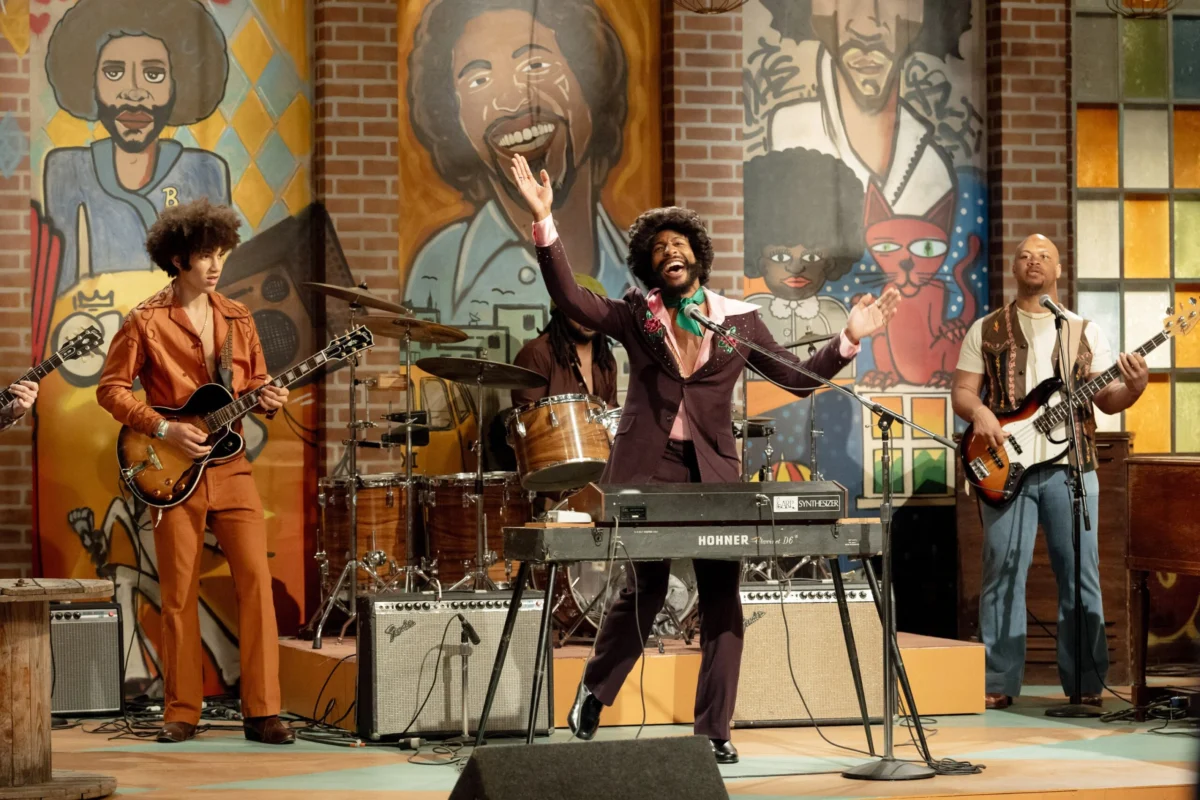
The magic of Jason Reitman’s Saturday Night—a frantic, high-stakes retelling of the ninety minutes leading up to the 1975 premiere of Saturday Night Live—lies in its refusal to be a static museum piece. While much has been written, and rightly so, about the cast’s ability to breathe new life into the comedy legends of the original Not Ready for Prime Time Players, the film’s most singular achievement is its pulse. It is not merely a film about a show; it is a film that breathes with the frantic, sweat-drenched, and exhilarating rhythm of live television.
At the heart of this kinetic energy is the film’s score. Composed by the multi-talented Jon Batiste, the music serves as the heartbeat of the production. Recorded live on set, the score does more than accompany the action; it embodies the ticking clock that serves as the film’s true antagonist. In an era where many film scores are meticulously polished in post-production, Batiste’s approach was radical: he brought his band onto the soundstage, capturing the raw, improvisational spirit of a group of artists racing against an impossible deadline.
The Architecture of Anxiety: A Chronology of the Score
The creation of the score for Saturday Night was a process defined by compression and collaboration. Because the film depicts the frantic final countdown to the launch of an American cultural institution, the production environment mirrored that same pressure.
Throughout the shooting schedule, after the cameras stopped rolling and the actors shed their 1970s period attire, the studio transformed. While the cast often lingered to watch, Batiste and a hand-picked ensemble of musicians would occupy the space, working for hours on cues that were often developed based on rough cuts provided by Reitman and his editing team.

This was not a traditional "spotting session" where a composer watches a locked cut and writes to the frame. Instead, it was an organic, iterative process. Batiste, often working with mere minutes to conceptualize a musical idea, would verbally explain the vision to his musicians—a practice rooted in the oral traditions of his upbringing in New Orleans. The band would then dive into the music, often nailing the final, definitive take on the first attempt. This spontaneity is what gives the film its raw, "live" quality; the audience isn’t hearing a finished, sterile recording, but rather a document of a specific moment in time.
Musical Lineage: The Oral Tradition
To understand the sound of Saturday Night, one must look to the lineage of the man behind the music. Jon Batiste’s approach to composing is inextricably linked to his background at the New Orleans Center for Creative Arts (NOCCA), an institution that counts legends like Wynton and Branford Marsalis, Harry Connick Jr., and Terence Blanchard among its alumni.
"The African diasporic tradition of learning music and passing on wisdom from the elders is an oral tradition," Batiste explains. "Yeah, you learn music from a page and from books, but you also learn it orally by sitting in a circle with an elder."
This method of teaching—passed down by mentors like the late Alvin Batiste, Ellis Marsalis, and Kid Jordan—is what allowed the Saturday Night score to flourish under pressure. By teaching his bandmates the music through conversation and collaborative play rather than rigid notation, Batiste bypassed the "composerly" detachment that often plagues modern cinema. He was not merely directing musicians; he was leading a conversation, much like the one Lorne Michaels had to lead on that fateful October night in 1975.

Supporting Data: An Eclectic Sonic Palette
Batiste drew from a wide, diverse array of influences to ground the film’s sound. He cited the nostalgic, character-driven score of American Graffiti, the sleek, amoral jazz sensibilities of Duke Ellington’s work for Anatomy of a Murder, and the tension-filled, cortisol-spiking electronic soundscapes of Trent Reznor and Atticus Ross for The Social Network.
However, the Saturday Night score is distinctly its own entity, a pressure cooker of influences:
- The Afro-Latin Diaspora: Through the inclusion of percussionist Pedrito Martinez, the score gains an rhythmic intensity that reflects the eclectic, melting-pot nature of 1970s New York.
- The Brooklyn Church Tradition: Organist Cory Henry brought a soul-infused, gospel-adjacent energy to the score, mirroring the "house band" style that would eventually become synonymous with SNL.
- The Ticking Clock: The musical cues are often discordant and howling, designed specifically to clash or syncopate with the film’s sound design, ensuring that the dialogue, music, and sound effects push the boundaries of traditional film mixing.
Official Perspectives: The Philosophy of the "Live" Score
In interviews with IndieWire, both Batiste and the production team emphasized that the goal was never for every element to line up neatly. The "villain" of the story is the clock, and the score needed to reflect the terrifying, beautiful chaos of a live broadcast.
"The sound and the room tone of the scenes is the same sound and room tone of the score," Batiste noted. "You’re connected to the energy of that day, and you’re with the cast and the crew and the director while making the music."

This commitment to physical space—recording the music in the same room where the action took place—created an "integrated" experience. The music is not a layer applied on top of the film; it is a participant in the environment. Batiste argues that this is a departure from the "orchestral, composerly" norms of modern cinema, where strings and timpani are used as crutches to tell the audience exactly how to feel. By breaking that paradigm, he has created something that feels remarkably present.
Implications for Future Filmmaking
The success of the Saturday Night score suggests a potential shift in how film music could be approached in the future. In an age of digital perfection, where every note can be nudged into alignment, there is a growing appetite for "presence."
Batiste believes that the "pocket of presence" he captured on set is a technique that could, and should, be replicated. "Even if you didn’t know how this score was made, you would still feel that presence," he says. The implications for the industry are clear: by prioritizing the communal, live, and reactive nature of performance over the detached, post-production-heavy model, filmmakers can create scores that feel deeply woven into the fabric of the narrative.
For Jason Reitman’s film, this approach was the only way to succeed. The story of Saturday Night is the story of a group of people coming together to create something that, by definition, can never be replicated. By recording the score in a way that mirrored this impermanence—acknowledging that the specific group of musicians, actors, and crew members would never be in that room together again—Batiste captured the fleeting, lightning-in-a-bottle spirit of the early SNL years.

Conclusion: A Living Soundtrack
As the credits roll on Saturday Night, the audience is left with the sensation of having survived a high-wire act. The music, which at times feels like it might tear itself apart, remains held together by the sheer force of its own conviction.
The miracle of the film is not just the performances or the meticulous production design; it is the fact that the intensity of those on-set, late-night recording sessions survived the editing process. When the viewer hears the music, they are hearing a real-time response to the chaos on screen.
In the end, the score for Saturday Night is more than a collection of cues. It is a testament to the power of the oral tradition and the necessity of collaboration. By trusting his musicians to play with the same reckless, visionary ambition as the original cast of SNL, Jon Batiste hasn’t just scored a movie—he has immortalized the sound of a dream coming to life in the nick of time. The score is not just a soundtrack; it is, in every sense of the word, live.
