
Unmasking the Eridian Echo: How James Ortiz Built Rocky’s Iconic, Glitchy Voice in Project Hail Mary

The massive box-office success of Amazon MGM Studios’ adaptation of Project Hail Mary caught the attention of sci-fi enthusiasts and mainstream moviegoers alike. Much of the film’s unexpected emotional core relies on the dynamic between Ryan Gosling’s resourceful molecular biologist, Ryland Grace, and his extraterrestrial companion, Rocky.
A crab-like, faceless Eridian hailing from a planet shrouded in darkness, Rocky communicates entirely through musical tones and chords rather than human speech. To bridge the gap, Grace deploys a makeshift computer translation system. Behind the physical puppetry and the intricate vocal design of this beloved character is James Ortiz. In an exclusive interview, Ortiz revealed the meticulous, behind-the-scenes choices he made to bring Rocky to life—including a subtle vocal detail meant to mimic the fragile, jury-rigged technology of Grace’s translation software.
Main Facts: The Anatomy of an Alien Voice
- The Character: Rocky is an Eridian from the planet Erid who forms an unbreakable bond with Ryan Gosling’s Ryland Grace while both struggle to save their respective solar systems from a light-devouring space microbe known as astrophage.
- The Dual Role: James Ortiz served as both the physical puppeteer for Rocky on-set and the primary voice actor, a casting choice that directors Phil Lord and Chris Miller ultimately decided to keep in the final theatrical cut.
- The Glitchy Aesthetic: To represent the fact that Rocky’s translated English is being pumped through a rushed, improvisational software loop, Ortiz deliberately infused his vocal performance with an intentional, analog-style buffering effect—akin to "two laptops duct-taped together."
- The Evolution of Language: As the narrative progresses, Rocky’s delivery shifts from rigid, mechanical translations to a more poetic and naturalistic cadence, reflecting his increasing comfort with human concepts and language.
Chronology: From On-Set Placeholder to Final Cut
1. The Accidental Audition
When James Ortiz first stepped onto the set of Project Hail Mary to operate Rocky’s complex physical rig, voicing the character was treated as a temporary measure. Like many practical production choices, Ortiz was simply reading the lines live to give Ryan Gosling something tangible to bounce his emotional beats against. He operated under the assumption that directors Phil Lord and Chris Miller would eventually hire a high-profile Hollywood voice actor to dub over his performance in post-production.

2. Crafting the "Duct-Tape" Algorithm
Because Grace’s translation system was built hastily out of emergency shipboard hardware, Ortiz recognized that the audio output shouldn’t sound like a pristine, high-end artificial intelligence. Instead, it needed to capture the scrappy, desperate nature of hard sci-fi survival.
"I was actually vocally really interested in how much [Rocky’s] voice box would be buffering and going wrong," Ortiz explained in an exclusive interview with /Film. "Because it’s two laptops duct-taped together."
Ortiz began utilizing a specialized vocal affectation, intentionally stumbling over cadences and injecting a jagged, robotic stutter into his natural delivery.

3. Editorial Experimentation
During early editing passes, directors Lord and Miller tested the waters of digital manipulation. In scenes where Ryland Grace cycles through various software settings to find the right baseline for Rocky’s voice, the editing team took multiple audio takes of Ortiz and spliced them together. This post-production layering created a purposefully fractured, erratic sound. However, once the baseline voice was established, the vast majority of what audiences hear in the finished film is purely Ortiz’s live vocal performance, relying on his own analog mimicry of a glitchy AI rather than heavy computer generation.
4. The Linguistic Shift
As Rocky and Grace spend months working side-by-side in deep space, the nature of their communication evolves. Ortiz had to calibrate his vocal performance to map onto this growing intimacy. Rather than treating English as a blunt instrument of survival, Rocky begins using human speech with a rhythmic, poetic quality, demanding a softer, more nuanced vocal approach from the actor in the film’s final third.
Supporting Data: Behind-the-Scenes Production Realities
- Hard Sci-Fi Authenticity: Based on Andy Weir’s critically acclaimed 2021 novel, Project Hail Mary maintains a strict adherence to real-world physics and engineering logic—a detail heavily praised by prominent science communicators like Neil deGrasse Tyson.
- Layered Easter Eggs: Beyond Ortiz’s vocal performance, the film is packed with hidden gems for long-time fans of the source material, including a subtle cameo appearance by Ray Porter, the narrator of the original Project Hail Mary audiobook.
- Practical Effects Renaissance: The reliance on practical puppetry for an alien character—rather than a fully computer-generated creature—allowed for organic interactions on set, directly contributing to the palpable chemistry between Gosling and Ortiz’s puppet.
Official Responses and Industry Reception
The decision by filmmakers Phil Lord and Chris Miller to retain Ortiz’s original vocal tracks highlights the unique authenticity he brought to the production. Initially hired strictly for his mastery of puppetry arts, Ortiz’s organic understanding of character pacing and emotional subtext elevated Rocky from a simple CGI or practical prop into a fully realized, empathetic protagonist.
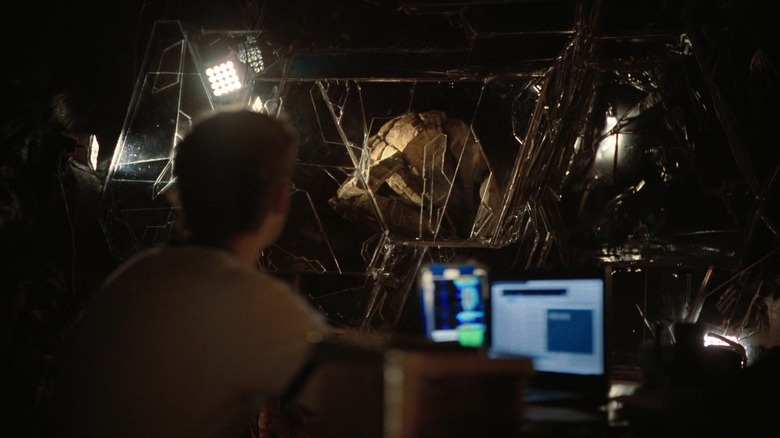
Critics and audiences alike have pointed to Rocky as the breakout emotional anchor of Project Hail Mary. Balancing the demands of hard science fiction with heartwarming buddy-comedy dynamics is notoriously difficult. Yet, Ortiz managed to thread the needle, creating an entity that sounds convincingly technological while remaining profoundly human. Even hardline scientific purists, notoriously critical of Hollywood’s handling of scientific principles, have embraced the film’s meticulous world-building and character design.
Implications: What This Means for Future Sci-Fi Creature Design
The success of Rocky’s voice design in Project Hail Mary points to a broader shift in modern blockbuster filmmaking. In an era dominated by automated generative AI voices and hyper-polished synthetic sound design, James Ortiz’s analog, human-driven performance proves the enduring value of physical craft.
By intentionally introducing flaws—simulating buffering errors, processing delays, and linguistic adaptation through sheer vocal control—Ortiz and the film’s creative team demonstrated that technical limitations can be transformed into powerful storytelling tools. As Hollywood continues to adapt complex hard sci-fi novels, the choice to prioritize tactile, actor-driven creature design over sterile digital shortcuts may well become the gold standard for breathing life into the universe’s most unusual characters.
