
Chart-Topping Magic and Monster Beats: Inside the Phenomenal Success of Netflix’s ‘KPop Demon Hunters’
By Entertainment Desk
Published: July 2026
In the crowded landscape of streaming entertainment, few hybrid projects manage to capture the elusive lightning-in-a-bottle synergy of music and narrative quite like Netflix’s original animated feature KPop Demon Hunters. Directed by Maggie Kang and Chris Appelhans, the film has proven to be an unmitigated global juggernaut since its June 20 debut.
Merging the high-octane choreography, infectious hooks, and sleek aesthetics of the contemporary global K-pop phenomenon with a high-stakes supernatural battle for the soul of humanity, the film has shattered expectations. It has dominated international pop charts, driven global streaming metrics, and redefined what an animated musical soundtrack can achieve in the modern media landscape.
Main Facts
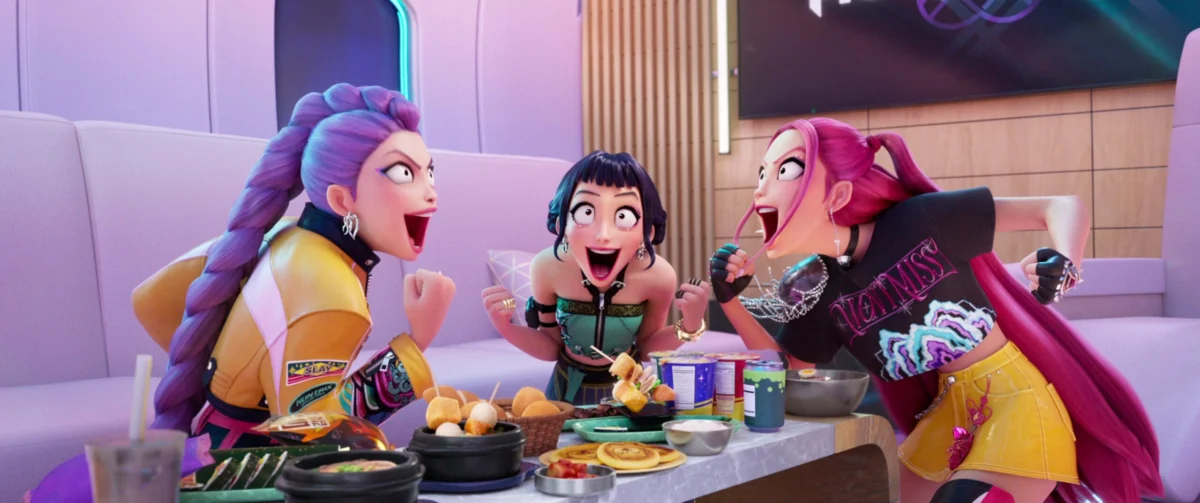
At its core, KPop Demon Hunters follows the fictional K-pop trio Huntr/x—composed of members Rumi (voiced by Arden Cho), Mira (May Hong), and Zoey (Ji-young Yoo). By day, they are international pop royalty selling out stadiums and dominating global charts; by night, they serve as a clandestine elite squad of demon hunters.

The narrative thrust of the film accelerates when a formidable rival boy band, the Saja Boys, bursts onto the scene. Beneath their squeaky-clean, irresistible facade, the boys are revealed to be demons in disguise. This leaves Huntr/x as the world’s sole line of defense against an apocalyptic supernatural threat.
The film’s success extends far beyond standard streaming view counts. According to Netflix’s performance metrics for the week ending July 13, KPop Demon Hunters has spent four consecutive weeks occupying a coveted spot in the Netflix Global Top 10 (English language). It recently reclaimed the #1 position globally, surging past Charlize Theron’s high-profile action sequel The Old Guard 2.
Simultaneously, the film’s accompanying music has transcended the medium of animation entirely. Singles like "Golden"—performed by Huntr/x—have claimed the #1 spot on both the Billboard Global 200 and Billboard Global Excluding U.S. charts. Netflix has confirmed that the track will be aggressively pushed for upcoming awards consideration.
Meanwhile, the Saja Boys’ infectious track "Your Idol" recently dominated the US Spotify chart, cementing the fictional group as the highest-charting K-pop entity in Spotify history, outperforming real-world juggernauts like BTS. The official movie soundtrack currently holds the #2 spot on the Billboard Global 200.

Chronology of Development
The journey of KPop Demon Hunters from an ambitious pitch to a global cultural phenomenon spans years of meticulous cross-disciplinary collaboration, helmed by co-directors Maggie Kang and Chris Appelhans alongside producer Michelle Wong.
Pre-Production and Songwriting (2024–2025)
Unlike traditional animated musicals where songs are retrofitted to existing scripts or written by a single in-house composer, the production team made a daring executive decision: they wanted to create an authentic K-pop album that could stand entirely on its own merit while simultaneously serving the film’s narrative arc.
For a full year before the animation and final songwriting sessions began, the directors worked in tandem with executive music producer Ian Eisendrath and Sony Pictures Animation. Eisendrath collaborated with a veritable "dream team" of premier K-pop hitmakers, including top-tier writers and producers from South Korea’s renowned The Black Label, alongside industry heavyweights like Stephen Kirk, Jenna Andrews, Lindgren, EJAE, and Mark Sonnenblick.
Rather than relying on a linear composition process, the team utilized a pop-music "song camp" model. Multiple iterations of every track were generated. For major cues like the film’s anthem "Golden," the team went through five distinct writers and seven completely different musical versions before landing on the final product as late as December of the previous year—an exceptionally tight timeline for feature animation production.

Premiere and Initial Streaming Run (June 20, 2026)
KPop Demon Hunters premiered globally on Netflix on June 20, 2026. Almost instantly, the film bypassed standard animation niches to capture a broad, multigenerational audience. While temporarily unseated from the #1 Netflix spot in early July by The Old Guard 2, the film exhibited rare staying power, surging back to the top position on the strength of word-of-mouth and viral social media trends.
Supporting Data and Metrics
The quantifiable impact of KPop Demon Hunters is unprecedented for an animated Netflix release:
- Streaming Longevity: Four weeks firmly anchored in the Netflix Global Top 10 (English), anchored by 40,400,000 viewing hours during the tracking week ending July 13.
- Billboard Domination: "Golden" hit #1 on both the Billboard Global 200 and Billboard Global Excluding U.S. charts.
- Spotify History: Saja Boys’ single "Your Idol" broke records by topping the US Spotify chart, briefly outperforming real-world streaming records held by groups like BTS.
- Soundtrack Performance: The KPop Demon Hunters original soundtrack locked down the #2 spot on the Billboard Global 200.
- Iterative Volume: Over 30 total songs were workshopped and considered, with between three and seven finalized versions produced for every musical cue in the script.
Official Responses and Creative Insights
In an exclusive interview with IndieWire, executive music producer Ian Eisendrath broke down the creative philosophy, collaborative hurdles, and surreal moments of validation that accompanied the film’s rollout.
The Directive: Real K-Pop, Real Authenticity
When asked about his initial marching orders, Eisendrath emphasized that compromise was never an option.

"The directive was very much, ‘We want to create a soundtrack of real K-pop hits,’" Eisendrath said. "This is not one of those films where it’s like, ‘Let’s hire some people to write in the style of it.’ This soundtrack needs to land and exist as a K-pop album, but also work within the film and cover the narrative territory it needs to cover."
The "Song Camp" Collaborative Process
Eisendrath highlighted the unconventional use of pop-music writing camps—a staple of the modern Seoul and Los Angeles pop industries—as the secret weapon behind the film’s musical texture.
"Spring at Sony had assembled this army of K-pop writers… There was so much cross-pollination. It was truly an ensemble of writers, which happens in pop music… but usually not in film."
This approach allowed the team to constantly swap songs and lyricists until each track felt organic to the characters. For instance, creating "Soda Pop" required walking a delicate tightrope: the song needed to function as an irresistibly catchy, squeaky-clean pop tune that audiences—and the on-screen fans—would instinctively fall in love with, while carrying a dark, double-meaning subtext hinting that the Saja Boys were actually supernatural predators looking to "devour" their listeners.

The Evolution of "Golden"
The film’s breakout anthem, "Golden," required an immense amount of trial and error to satisfy multiple dramatic requirements simultaneously.
"It had to serve the function of what in most film musicals is called the ‘I want song,’" Eisendrath explained. "It had to establish what the group wanted, which was to seal the Honmoon and basically conquer all… And at the same time, it had to somehow uncover Rumi’s deeper need and want, which is to erase the demon patterns, which is the moment the audience realizes, ‘Oh, my gosh, she’s a demon.’"
Following a grueling iterative process led by top-line writer EJAE Kim and lyricist Mark Sonnenblick, the team finalized the track just months before the film’s completion.
Cultural Resonance and Viral Validation
Seeing the project resonate deeply with real-world K-pop fandoms—including viral TikTok dance covers, YouTube vocal renditions, and even a playful livestream riff of "Soda Pop" by members of BTS—has been the ultimate reward for the creative team, particularly co-director Maggie Kang.

"This project is Maggie Kang’s. This is so deeply from her brain and heart," Eisendrath noted. "She loves K-pop, and that was such a driving force… To see that the Korean culture feels like it was created by them and that they loved it, I don’t think there’s any greater reward."
When asked about the prospect of returning to the universe for a potential sequel, Eisendrath didn’t hesitate: "I would love it. It would be a dream. I could do this forever."
Implications for the Industry
The unprecedented cross-platform success of KPop Demon Hunters carries significant implications for both the animation industry and the global music business:
- The Death of "Novelty" Movie Songs: Historically, animated musicals relied on show tunes designed strictly to advance plot points, often failing to break out on mainstream pop charts. KPop Demon Hunters proves that audiences demand—and commercial radio/streaming algorithms will reward—fully realized, genre-authentic pop production that happens to live inside a narrative framework.
- Cross-Cultural Collaborations as the Gold Standard: By actively integrating Korean songwriting camps, K-pop production houses (such as The Black Label), and Hollywood animation pipelines, Sony and Netflix have established a new template for representing foreign cultural phenomena with absolute authenticity.
- Franchise Expansion and Music-First Marketing: With the soundtrack dominating global charts and outperforming traditional pop releases, Netflix has discovered a potent marketing engine. The music does not merely promote the film; it operates as an independent revenue stream and cultural touchstone, all but guaranteeing that discussions for a KPop Demon Hunters sequel will move swiftly from fan speculation to greenlit reality.
KPop Demon Hunters is currently streaming worldwide on Netflix, with its companion soundtrack available across all major digital music platforms.
