Bridging the Cosmic Gap: How ‘Lanterns’ Episode 6 Finally Connects to DCU Continuity
Main Facts: Crossing the Streams of the New DC Cinematic Universe
From the moment HBO announced its prestige-tier streaming series Lanterns, a massive narrative elephant loomed large over the production: How would the show reconcile its veteran-heavy interstellar mystery with James Gunn’s overarching reboot of the DC Cinematic Universe (DCU)?
While viewers have spent weeks basking in the crackling, complex onscreen chemistry and ideological rivalry between veteran Hal Jordan (Kyle Chandler) and newcomer John Stewart (Aaron Pierre), hardline continuity enthusiasts have long known a critical piece of trivia. According to the foundational lore established in James Gunn’s cinematic relaunch in Superman, Earth’s active, primary Green Lantern in the modern timeline is actually the brash, polarizing Guy Gardner (played by Nathan Fillion).
That long-standing continuity question was finally answered in explosive fashion during the sixth episode of the HBO series, titled “Bad Optics.” Written by Lanterns co-creators Damon Lindelof and Tom King, the milestone episode bridges the gap between the terrestrial chaos of the mid-2010s and the modern 2026 DCU timeline. In doing so, it ties up several loose narrative threads, recontextualizes the shocking cliffhanger from the series premiere, and introduces a canonical heavy-hitter that alters the cosmic chess board forever.
Chronology: From Rushville’s Ashes to the Grave of a Hero
The Aftermath and the Architect
“Bad Optics” wastes no time recalibrating the narrative scope of the series. Following the catastrophic fallout of the Battle of Rushville, the episode jumps ahead to the present day of 2026. John Stewart, having famously surrendered his Green Lantern ring when he was finally handed the mantle, has retreated from the stars to return to his roots as an ordinary man.
Now working as an architect alongside his brother, John is attempting to pitch city governments and the U.S. military on an innovative concept: reinforced, highly resilient subterranean shelters he dubs “arks.” These structures are designed to safeguard regular, non-powered citizens from the devastating collateral damage of superhuman conflicts—disasters mirroring the localized destruction of Rushville or the near-collapse of Metropolis seen in Superman.
While John’s municipal pitch goes swimmingly, he is soon drawn back to the very place he tried so hard to leave behind. Despite a childhood spent training intensely to surpass Hal Jordan—instructions drilled into him by his own mother—John receives an unexpected call from her urging him to seek out Hal for a reconciliation.
The Diner Confrontation and the Shadow of Guy Gardner
The ensuing meetup between John and Hal plays out like a classic cinematic standoff, channeling the tense, professional friction of Michael Mann’s Heat inside a sleepy suburban diner.
During their tense exchange, the two men obliquely reference the new status quo on Earth, dropping references to “that gym teacher on TV”—a jab at Guy Gardner. In a clever wink to DC Comics continuity, Hal bitterly notes that Gardner even “ripped off that Bat-guy over in Gotham” by planting a conspicuous Green Lantern beacon right in the center of Rushville.
However, neither man seems to realize just how hostile the locals of Rushville remain toward the Corps. Shortly after parting ways, John receives a devastating phone call from Kerry (played by Kelly Macdonald): Hal Jordan has turned up dead. This tragic twist loops the narrative directly back to the shocking cliffhanger introduced in the series premiere.
Vigilante Justice and the Cellblock Reunion
Hal’s death is met with open celebration among the residents of Rushville, who still harbor deep-seated resentment over the events surrounding the Manhunter incident. The hostility boils over instantly when John activates the Green Lantern signal. A truckload of local vigilantes—led by Billy (Jason Ritter), the husband of Kerry—arrives looking for a fight.
Underestimating John Stewart proves to be a fatal tactical error for the locals. John effortlessly dismantles the group, leaving Billy and his associates sprawling on the pavement, gasping for air.
Paradoxically, John goes straight from hospitalizing Billy to sharing a meal with Billy’s wife, Kerry. When Kerry learns the truth of the street brawl, she has John thrown into the local jail—ostensibly to protect him from the hostile townspeople as much as to punish him. It is behind these iron bars that John finally comes face-to-face with Earth’s current ring-bearer: Guy Gardner.
Gardner wastes no time rubbing salt in the wound, noting that the antics of Hal and John a decade prior “really damaged the brand” of the Green Lantern Corps. Guy recounts how Hal told him to “go climb a rope” when he sought mentorship, highlighting Hal’s intense possessiveness over his title. When Guy proves unhelpful, John deploys a psychological masterstroke:
"Guy, everything you have is because I didn’t take it."
Stung by the cold reality of John’s words, a guilty Gardner relents, retrieving Hal’s decommissioned ring so that the fallen hero can be buried with full Corps honors. Before departing, Guy drops a massive galactic bombshell: a high-security space prison break has occurred, and Sinestro (Ulrich Thomsen) is officially on the loose.
The Holographic Sentry and Hal’s Final Stunt
As funeral preparations get underway, John is introduced to Carol Ferris (Amie MacKenzie), Hal’s longtime romantic partner. Carol delivers a final piece of business from the grave: Hal wrote his own eulogy, but insisted that John be the one to deliver it.
Reflecting on the unique funeral arrangements, Kelly Macdonald noted in a behind-the-scenes featurette:
"The funeral scene is very Hal. It feels like he’s stunting at the gravesite."
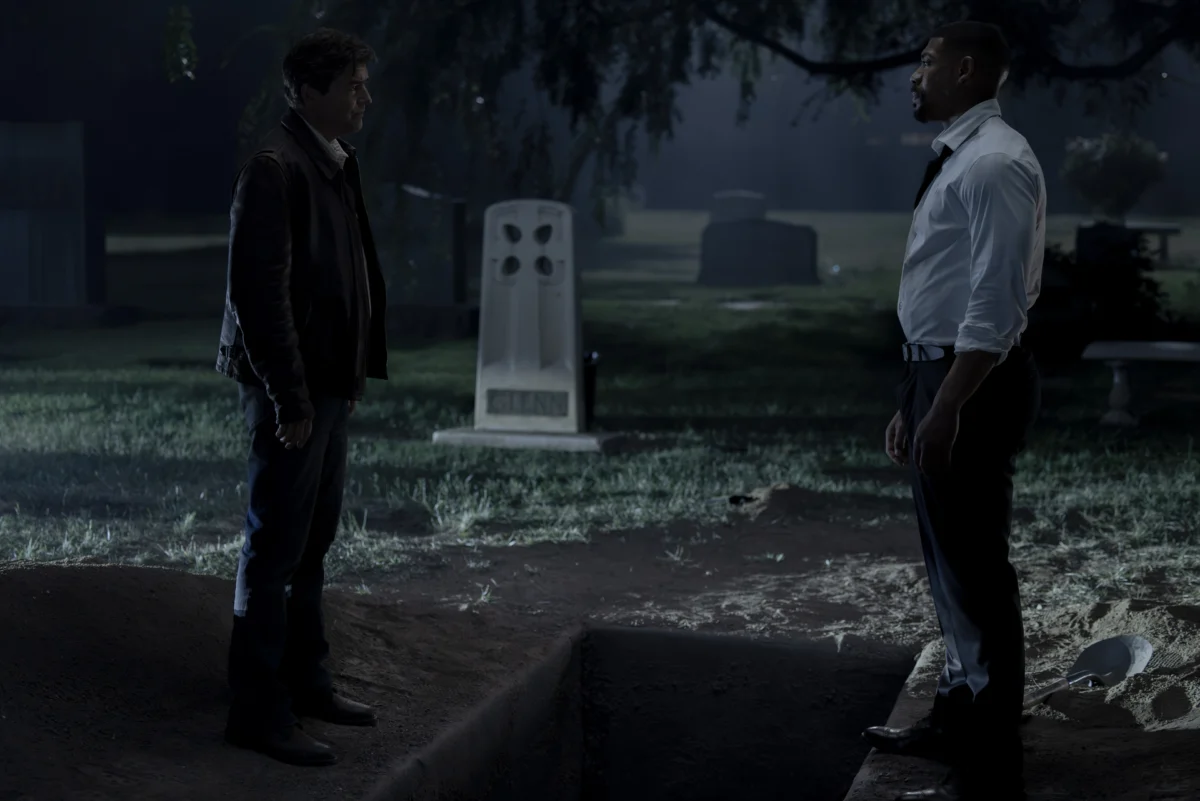
After delivering the eulogy, John returns to the freshly dug grave under the cover of night. Using his bare hands, he exhales and digs up the coffin. The true motive behind forcing Guy to retrieve Hal’s ring is finally revealed: John intends to activate the Corps’ “sentry protocol,” utilizing Hal’s pre-programmed holographic backup to investigate and solve his own murder.
Supporting Data: Cast, Crew, and Creative Breakdown
Production Element
Details & Personnel
Series Title
Lanterns (HBO / DC Studios)
Episode
Season 1, Episode 6: "Bad Optics"
Writers
Damon Lindelof, Tom King
Showrunners / EPs
Damon Lindelof, Tom King, Chris Mundy
Key Cast Members
Aaron Pierre (John Stewart), Kyle Chandler (Hal Jordan), Nathan Fillion (Guy Gardner), Kelly Macdonald (Kerry), Jason Ritter (Billy), Amie MacKenzie (Carol Ferris), Ulrich Thomsen (Sinestro)
Continuity Tie-In
Directly links to James Gunn’s Superman (2025/2026 release window)
Official Responses: Behind the Scenes of a Hero’s Demise
Killing off a legendary comic book icon like Hal Jordan is never a decision made lightly by creators. In post-episode featurettes, the creative triumvirate behind Lanterns—Damon Lindelof, Tom King, and Chris Mundy—opened up about the agonizing choice to remove Chandler’s character from the active playing field.
Mundy explained that while writing off Hal permanently cuts short his physical presence in the narrative, it was fundamentally necessary to justify John Stewart’s return to the toxic environment of Rushville after their bitter falling-out.
"For us, it was a way to deepen Hal, even though he wasn’t gonna go forward," Mundy observed.
Furthermore, writer Justin Britt-Gibson pointed out that Hal’s trajectory serves as a cautionary tale for anyone who bears the emerald light. The tragedy of Hal Jordan isn’t just that he died; it’s how the power warped him.
"What I want audiences to take away from that scene is, look what this ring did to Hal Jordan," Britt-Gibson remarked. "It made him so possessive, it made him so selfish."
Implications: What Hal Jordan’s Death Means for the Future of the DCU
The implications of "Bad Optics" stretch far beyond a simple murder mystery. By officially killing off Hal Jordan and transitioning the mantle firmly to Guy Gardner (with John Stewart operating in a complex, retired-yet-consulting capacity), Lanterns has successfully mapped out the generational trauma and politics of the Green Lantern Corps within James Gunn’s new DCU.
The Sinestro Threat: With Sinestro out of space prison, the scope of the series is poised to transition from a grounded terrestrial murder mystery into a cosmic-scale threat that will require the combined forces of Earth’s disparate Lanterns.
The Burden of the Ring: The exploration of the ring’s psychological toll—highlighted by Britt-Gibson’s comments on Hal’s selfishness—suggests that the DCU’s Green Lanterns will not be portrayed as straightforward, flawless Boy Scouts. Power comes with profound corruption.
Continuity Harmony: By cementing Guy Gardner as Earth’s active public-facing hero while exploring the historical friction between Hal and John, the series satisfies comic purists while keeping its narrative deeply personal and character-driven.
As John boots up Hal’s holographic ghost to solve a murder committed against a man who hated successors, Lanterns proves that in the new DCU, even death is just the beginning of the investigation.